Silouan the Athonite is a saint of the Catholic Church (1866 - 1938). Silouan the Athonite's feast day is celebrated on 24 September.
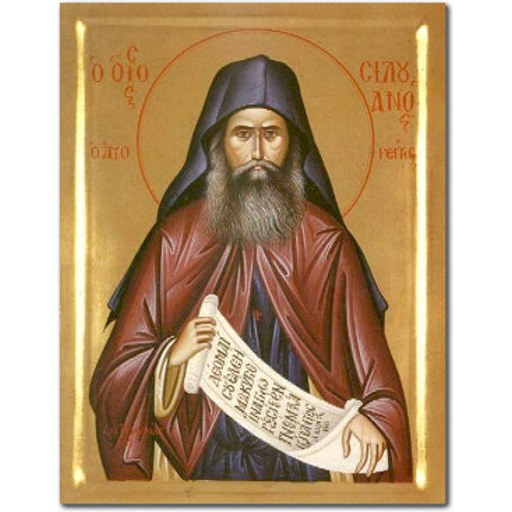
Jack1956
License: Public domain
Silouan the Athonite
Saint- Life Span
- 1866 - 1938 (age 72)
- Feast Day
- 24 September
- Gender
- male
- Church
- Catholic
Places
Roles & Family
Religious Information
Canonization
Biography
Simeon Ivanovich Antonov, later venerated as Saint Silouan the Athonite, was born in 1866 in the village of Sovsk in the Tambov Governorate of the Russian Empire, into a devout peasant family. His father, Ivan, was remembered in the family tradition for patience, fairness, and a simple Christian wisdom that left a deep mark on his son. Simeon grew up working the land and living the ordinary life of a Russian villager. After a period of youthful roughness and waywardness he underwent a decisive conversion, which later accounts associate with a dream in which the Mother of God reproached him. He then resolved to enter monastic life, but first completed his term of military service in the Imperial Russian Army. During that service he went to Kronstadt seeking the prayers of the well-known pastor John of Kronstadt. In 1892 he left Russia for Mount Athos and was received at the Russian Monastery of Saint Panteleimon, known as the Rossikon.
At Saint Panteleimon he was tonsured a monk and given the name Silouan. He was never ordained to the priesthood and remained a simple monk, later a monk of the great schema, serving the community in humble obediences. These included labor at the monastery mill and, in time, responsibility as steward over workshops and workers. Early in his monastic life, after a season of intense prayer and inner trial, he received a vision of the living Christ in the church of the Holy Prophet Elijah attached to the mill, an experience that shaped the rest of his spiritual life. He then endured many years of severe inner struggle, including demonic assaults and a sense of God-forsakenness. From that struggle came the counsel he always attributed to Christ: to keep the mind in hell and not to despair. He practiced the Jesus Prayer with great concentration and became known among the brethren for meekness, tears of repentance, and unceasing intercession.
Silouan taught that a true sign of the Holy Spirit is love for all people, including enemies, and prayer even for those in hell. He spoke of bearing in himself the whole of Adam and of praying for the entire human race as for his own life. Though he had little formal schooling, he dictated reflections on prayer, humility, repentance, and the knowledge of God. These texts were preserved by his closest disciple, Archimandrite Sophrony (Sakharov), who lived on Athos in the 1930s, knew Silouan in the last years of his life, and later founded the Monastery of Saint John the Baptist in Essex, England. Through Sophrony’s biography and edition of the writings, Silouan became known far beyond Athos as a teacher of the Jesus Prayer and of compassion for the whole world.
Silouan died at the Monastery of Saint Panteleimon on 24 September 1938. He was buried on Mount Athos, and his memory remained especially tied to that Russian monastery. In 1987 he was glorified as a saint by the Ecumenical Patriarchate of Constantinople; his feast is kept on 24 September, and he is also commemorated in the calendars of other Orthodox churches, including the Russian Orthodox Church. He is widely regarded as one of the principal Athonite spiritual figures of the twentieth century, cited for humility, unceasing prayer, and love for all humanity.