Silvester of Troina is a saint of the Catholic Church (d. 1164). Silvester of Troina's feast day is celebrated on 2 January. Silvester of Troina is the patron saint of Troina.
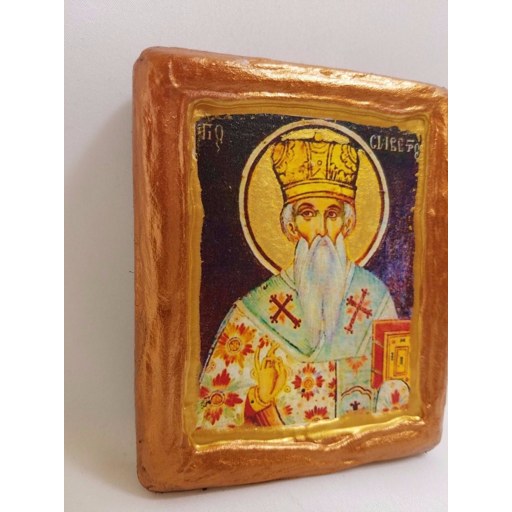
https://www.ebay.com/itm/183753369467
License: unknown
Silvester of Troina
Saint- Life Span
- d. 1164
- Feast Day
- 2 January
- Gender
- male
- Church
- Catholic
Places
Roles & Family
Religious Information
Patronage
Troina
Biography
Silvester of Troina, known in Italian as Silvestro da Troina, was a monk and hermit of twelfth-century Sicily who is venerated as a saint in the Catholic Church. He was born at Troina, in the mountainous interior of the island (in what is now the province of Enna), at the beginning of the twelfth century, when Norman rulers were consolidating their power over a mixed Greek, Latin, and Arab population. No contemporary charter or chronicle records his family, the exact year of his birth, or the circumstances of his youth. Later local tradition, as transmitted in Italian hagiographical compilations, states that he entered monastic life at a Basilian community in or near Troina, generally identified with the monastery of San Michele, which followed the Greek Rule of Saint Basil the Great. Northeastern Sicily in this period still retained a strong Italo-Greek monastic culture, even as Latin bishoprics and Benedictine houses spread under Norman patronage.
After living for a time in community, Silvester obtained leave to take up the eremitical life and withdrew to a cave or hermitage in the countryside surrounding Troina. Tradition associates a grotto near the town, later a site of popular devotion, with his cell. There he was remembered for austerity, prayer, and a reputation for holiness that drew the sick and the troubled to seek his counsel and intercession. The particular miracles later attributed to him belong to the conventional stock of medieval southern Italian hagiography and cannot be verified from independent twelfth-century sources. What is historically more secure is the endurance of his fame as a wonder-working hermit among the people of the Nebrodi region. He is thus best understood as one of the local holy men who embodied the older Greek ascetic tradition within Norman Sicily, rather than as a figure whose biography can be reconstructed in close detail.
According to the date preserved in martyrological and local tradition, Silvester died at Troina on 2 January 1164. He was buried in the town, and his relics have continued to be venerated there, above all in connection with the Chiesa Madre of Troina. His cult did not become a wide international devotion; it remained centered on his native city, of which he is the principal patron saint. The liturgical memorial is kept on 2 January. No authentic papal bull of canonization from the later Middle Ages is known. Like many saints of the eleventh and twelfth centuries, he appears to have been recognized through popular veneration and eventual liturgical reception rather than through a surviving formal process of canonization or beatification. As a professed monk and hermit he lived in celibacy and is not recorded to have married or had children, nor did he hold papal or patriarchal office.
Modern notices of Silvester are brief and largely dependent on the same local tradition. Standard repertoires of saints, including entries that stand behind the Roman Martyrology and Italian collections associated with the Bibliotheca Sanctorum, agree in identifying him as a Basilian monk-hermit of Troina who died in the mid-twelfth century, but they do not recover a verifiable birth year or a contemporary vita of independent historical value. He should not be confused with other medieval saints named Silvester, including Pope Sylvester I. His historical significance lies in the religious life of Norman Sicily and in the civic identity of Troina, where his memory, relics, and hermitage have been maintained for centuries despite the scarcity of early written evidence.