Simeon is a saint of the Catholic Church.
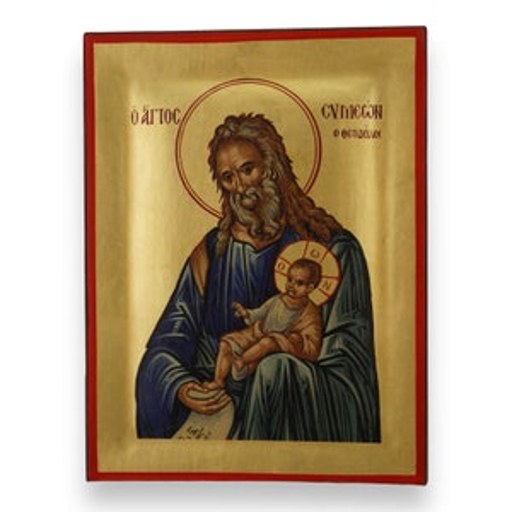
https://www.etsy.com/market/st._simeon_icon
License: unknown
Simeon
Saint- Gender
- male
- Church
- Catholic
Biography
The single given name Simeon (Hebrew Shimʿon) is shared by many figures in biblical, patristic, and later hagiographical sources. The query supplies no Wikidata identifier, no Wikipedia article, no epithet, no see, and no century. A careful historian therefore cannot treat any one of those men as the intended subject, and cannot assign a verified birth year, death year, birthplace, burial place, religious order, marital history, papal or patriarchal office, feast day, or patronage list without guessing. Several well-attested holy men named Simeon must be kept distinct.
In the Gospel of Luke, a righteous and devout man named Simeon in Jerusalem is said to have received the infant Jesus in the Temple and to have spoken the canticle later known as the Nunc dimittis. The evangelist gives no parentage, no age in years, and no date of death. Later Jewish and Christian writers sometimes tried to identify him with a son of Hillel or with other teachers, but those identifications are not secured by early evidence. Liturgical calendars came to commemorate him (often on 3 February in the Latin West, and with related observances in the East), yet a feast day is a cultic assignment, not a documented biographical date, and it cannot be used here as if it belonged to a uniquely identified subject.
A different Simeon, son of Clopas (Cleophas), appears in Eusebius of Caesarea, who follows Hegesippus in presenting him as a kinsman of Jesus and as bishop of Jerusalem after James. That tradition reports that he was crucified under the emperor Trajan at a very advanced age, commonly placed around the first years of the second century. Even if that martyrdom notice is accepted, his year of birth is unknown and must not be invented by subtracting a round number from the year of his episcopate or death. He is not the same person as the Simeon of Luke 2, nor as the later Syrian stylites.
Among later ascetics, Simeon Stylites the Elder, active in the region of Antioch in the fifth century, is the most famous pillar-saint of that name; conventional dating places his death in 459, while his birth is only approximately located in the late fourth century and is not a securely recorded year. Simeon Stylites the Younger, Simeon the New Theologian in middle Byzantine monasticism, and various bishops, martyrs, and Coptic or other hierarchs named Simeon or Simon form still further, separate dossiers. None of these lives may be merged, and none can be selected as “the” Simeon on the basis of the name alone.
Because the subject cannot be uniquely identified from the information given, every field that requires a single, source-verified fact is left empty rather than filled by conjecture. A usable biography would need at least an epithet (for example “the Stylite” or “the God-receiver”), a see, a century, or a stable catalogue identifier. Until that is supplied, the record remains a name only.