Simeon is a saint of the Catholic Church.
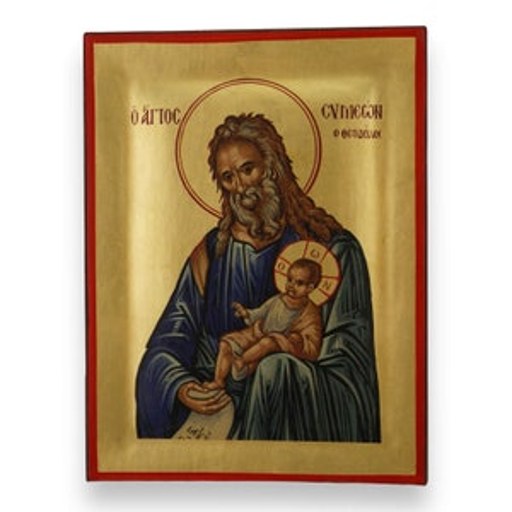
https://www.etsy.com/market/st._simeon_icon
License: unknown
Simeon
Saint- Gender
- male
- Church
- Catholic
Biography
The name Simeon (Greek Symeon; Hebrew Shimʿon) is borne by many biblical figures, bishops, monks, and saints. Without an epithet, feast day, see, or other identifier, a single verified biography, set of dates, or patronage list cannot be assigned to this subject. Person-specific fields are therefore left blank rather than filled by conjecture. The following summarizes the principal holy men of this name in historical and hagiographical sources, with dates given only where they rest on reasonably firm evidence.
In the New Testament, Simeon the God-receiver (also called Simeon the Righteous) appears in the Gospel of Luke as a devout man in Jerusalem who, having been promised that he would not die before seeing the Lord’s Messiah, took the infant Jesus in his arms at the Presentation in the Temple and uttered the canticle known as the Nunc Dimittis. The canonical text supplies no birth or death year, no parents, and no later career. Later legend, especially in Eastern homiletic and apocryphal tradition, sometimes identified him with a priest or even with one of the Septuagint translators and attributed to him an implausible lifespan; those elaborations are not historically verifiable. His commemoration is generally kept on 3 February in the Roman calendar (or in connection with the Presentation on 2 February) and on corresponding dates in Byzantine and other Eastern calendars.
A second early figure is Simeon, bishop of Jerusalem, whom Eusebius of Caesarea, drawing on Hegesippus, describes as the son of Clopas and a relative of Jesus, who succeeded James the Just in the Jerusalem episcopate and was crucified under the emperor Trajan. Traditional martyrologies place his death in the first decade of the second century and keep his feast on 18 February in the West. The report that he was one hundred and twenty years old at death is legendary and cannot be used to calculate a birth year. He was a bishop of Jerusalem, not Bishop of Rome, and the later patriarchal title of that see should not be read back anachronistically into his office.
Among later ascetics, Simeon Stylites the Elder is the best documented. Contemporary and near-contemporary writers, notably Theodoret of Cyrrhus, describe a Syrian monk born in the late fourth century at Sisan on the Cilician–Syrian frontier who, after years in monasteries and in an enclosure at Telanissus, mounted a succession of pillars and remained on the last of them until his death in 459 near what is now Qalʿat Simʿān, east of Antioch. He was neither married nor a bishop. His cult spread rapidly in East and West; Western calendars often keep him on 5 January, Eastern ones on 1 September. Other stylites of the same name (including Simeon Stylites the Younger of the Wondrous Mountain, who died in the sixth century) are distinct persons. Still other notable bearers include Symeon the New Theologian, a Byzantine monastic writer born in the mid-tenth century in Paphlagonian Galatia and deceased in 1022; Symeon Metaphrastes, the tenth-century compiler of a famous menologion; and several Coptic popes of Alexandria named Simeon or Simon in the early medieval period. Each of these men has his own dates, feast, and dossier. Until the subject is identified more precisely, no single year of birth or death, place of burial, religious order, patronage, or act of canonization can be verified.