Simeon is a saint of the Catholic Church.
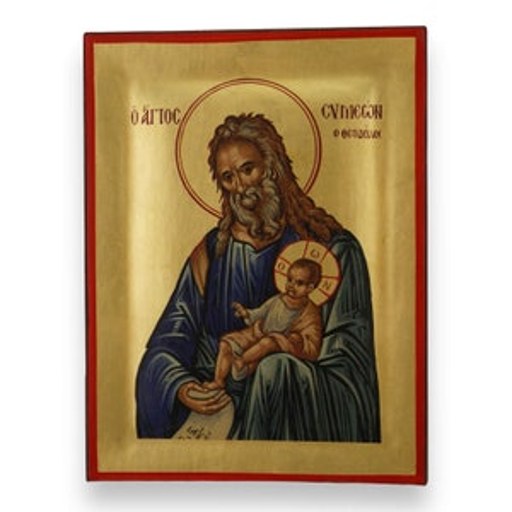
https://www.etsy.com/market/st._simeon_icon
License: unknown
Simeon
Saint- Church
- Catholic
Biography
The single name Simeon (also spelled Symeon) is borne by many distinct figures in Jewish scripture, early Christian history, and later hagiography. The request supplies no Wikidata identifier, no encyclopedia article, and no epithet, century, see, or feast by which one man could be isolated. A verified birth year, death year, birthplace, burial site, order, marriage, children, papal or patriarchal office, patronage list, or canonization cannot therefore be assigned without guessing, which the sources do not permit. The structured fields are left blank for that reason.
Among biblical and early Christian bearers of the name, the Gospel according to Luke describes a righteous and devout man in Jerusalem who had been told he would not see death before he had seen the Lord’s Messiah. He received the infant Jesus in the Temple and spoke the canticle later called the Nunc dimittis. The evangelist gives no parents, no year of birth or death, and no statement about a wife or children. Later legend sometimes identified him with a son of Hillel or claimed he had been one of the translators of the Septuagint and so lived for centuries; those elaborations are not historically verifiable and cannot be used to fill dates or places.
Eusebius of Caesarea, drawing on Hegesippus, records another Simeon as a relative of Jesus—son of Clopas—and as successor of James in the leadership of the Jerusalem church. Eusebius places his crucifixion in the reign of Trajan and reports an age of 120 years at death; that age is a hagiographical topos, not a usable birth date, and does not authorize an office-taking year to be entered as a year of birth. He is commemorated on differing days in Western and Eastern calendars, but those commemorations belong to this Jerusalem bishop only when he is explicitly so identified.
Still other widely venerated saints include Symeon Stylites the Elder, the fifth-century Syrian ascetic who lived for decades on a pillar and whose death in 459 is comparatively well attested; Symeon Stylites the Younger on the Wondrous Mountain; Symeon the New Theologian, the Byzantine monastic writer of the late tenth and early eleventh centuries; and Symeon Metaphrastes, the tenth-century compiler of saints’ lives. Each has his own region, approximate dates, burial tradition, and liturgical day. None of their particulars may be copied into the fields above while the subject remains only “Simeon.”
Because the name is so common, no single feast, patronage, religious order, or act of canonization or beatification can be stated as fact for this subject. Anyone requiring a complete biographical record must specify which Simeon is meant—by epithet, century, church, or feast—before the sources will support dates, places, or offices.