Simeon is a saint of the Catholic Church.
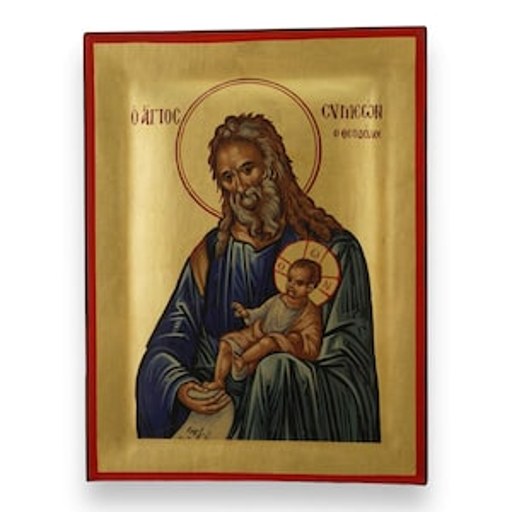
https://www.etsy.com/market/st._simeon_icon
License: unknown
Simeon
Saint- Gender
- male
- Church
- Catholic
Biography
The name Simeon (also spelled Symeon; from Hebrew Shimʿon) is borne by a large number of biblical, patristic, and later saints, and the subject as given cannot be identified with a single historical person. No unique, source-verified birth year, death year, birthplace, burial site, patronage list, or act of canonization can therefore be assigned. The best-known early figure is Simeon the Righteous, or Simeon the God-receiver, who appears in the Gospel of Luke as a devout man in Jerusalem who took the infant Jesus in his arms at the Temple and spoke the canticle later known as the Nunc dimittis. Later Eastern legend sometimes identified him with one of the Septuagint translators and attributed to him an implausibly long life; those elaborations are not historically demonstrable. His commemoration in the West is commonly 3 February, often linked to the feast of the Presentation.
A second early churchman is Simeon son of Clopas (Cleophas), whom Eusebius of Caesarea, citing Hegesippus, describes as a kinsman of Jesus and as successor of James the Just as bishop of the Jerusalem community. That tradition places his martyrdom by crucifixion under Trajan at a very advanced age, often given around the year 107, but the dates of his birth and death, and the place of burial, are not independently verified. Western martyrologies have often assigned him 18 February.
The most famous monastic bearer of the name is Simeon Stylites the Elder, a fifth-century Syrian ascetic who lived for decades on a pillar in the region of Aleppo and whose death is placed by ancient sources, including Theodoret of Cyrrhus, in 459. His example produced further stylites, notably Simeon Stylites the Younger on the Wondrous Mountain near Antioch in the sixth century. Other major figures include Symeon the New Theologian, a Byzantine abbot and mystical writer of the late tenth and early eleventh centuries, and Symeon Metaphrastes, the tenth-century compiler of a standard Greek menologion, as well as numerous local bishops, martyrs, and monks in Greek, Slavic, Armenian, and Latin calendars.
Because these men belong to different centuries, churches, and regions, they do not share a single feast day, religious order, marital status, or list of patronages. Fields in this record are left blank wherever a unique identification cannot be made from reliable historical sources. A particular saint named Simeon can be documented only if an epithet, see, century, or feast date is supplied.