Sisinnius, Martyrius and Alexander is a saint of the Catholic Church (d. 397). Sisinnius, Martyrius and Alexander's feast day is celebrated on 29 May. Sisinnius, Martyrius and Alexander is the patron saint of Val di Non;Sanzeno;Anaunia.
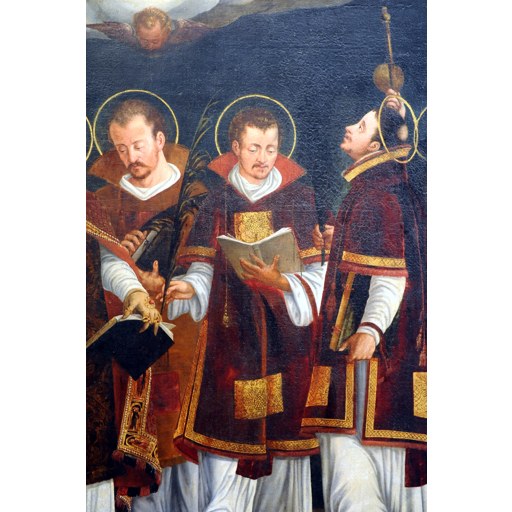
Niccolò Caranti
License: CC BY-SA 4.0
Sisinnius, Martyrius and Alexander
Saint- Life Span
- d. 397
- Feast Day
- 29 May
- Gender
- male
- Church
- Catholic
Places

Roles & Family
Patronage
Val di Non;Sanzeno;Anaunia
Biography
Sisinnius, Martyrius and Alexander were Cappadocian Christian clerics who were martyred in Anaunia, the Alpine valley now called the Val di Non in present-day Trentino, in the late fourth century. Contemporary evidence for their lives comes chiefly from two letters of Vigilius, bishop of Trent, written soon after their deaths to Simplicianus of Milan and to John Chrysostom. According to this testimony the three men had come from Cappadocia to northern Italy, where Vigilius received them, conferred on them the ranks of deacon (Sisinnius), lector (Martyrius) and ostiarius (Alexander), and sent them to evangelize a district that remained largely attached to traditional pagan cults. No independent source preserves the dates or places of their births or any details of their earlier lives in the East.
In Anaunia they gathered a small Christian community and maintained a place of worship. On 29 May 397, during a local pagan festival, they came into open conflict with inhabitants who were carrying out rites that the missionaries regarded as idolatrous. The letters of Vigilius describe a violent assault: the three clerics were seized, beaten, and burned. Sisinnius, the deacon, is presented as the leader of the group; Martyrius and Alexander shared his death in the same outburst of hostility. The episode is one of the last well-documented cases of popular pagan violence against Christian missionaries in the Alpine valleys of Roman Italy, in the generation after the Theodosian laws against public pagan worship.
Vigilius recovered their bodies and promoted their veneration. He informed the churches of Milan and Constantinople so that the martyrs would be commemorated beyond the local church of Trent. A sanctuary was established at the site of the martyrdom, the place later known as Sanzeno, a toponym derived from the name of Sisinnius. Their relics became the centre of a regional cult, and the three Anaunian martyrs entered the martyrologies of northern Italy. The Roman Martyrology records their feast on 29 May. Local tradition also connects their mission with the later death of Vigilius himself, who is said to have been killed in the nearby Val Rendena after overturning a statue of Saturn.
Historical knowledge of the three men depends almost entirely on Vigilius’s near-contemporary letters and on the continuous liturgical and local cult in the Val di Non and the diocese of Trent. They are honoured as the missionary martyrs who planted the church in Anaunia, and their shrine at Sanzeno remains the principal memorial of their death. Nothing reliable is known of spouses, children, or membership in a later religious order; they appear in the sources simply as missionary clergy of the church of Trent.