Sisto Riario Sforza is a venerable of the Catholic Church (1810 - 1877).
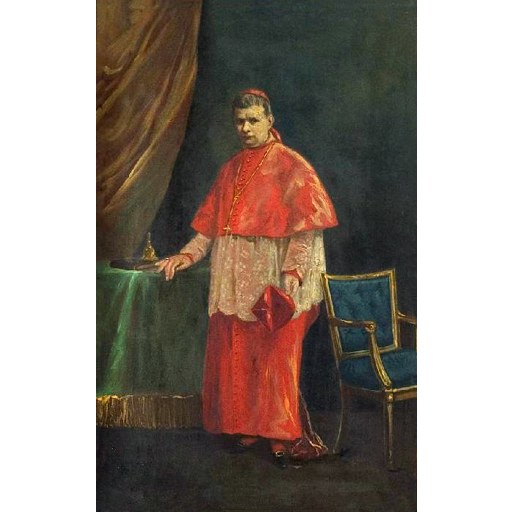
Ambito napoletano
License: Public domain
Sisto Riario Sforza
Venerable- Life Span
- 1810 - 1877 (age 67)
- Gender
- male
- Church
- Catholic
Places
Relics & Where to Venerate
Location unknown
The bodily remains of Sisto Riario Sforza are a first-class relic. Venerated at Naples Cathedral.
Roles & Family
Biography
Sisto Riario Sforza was born on 5 December 1810 in Naples, then the capital of the Napoleonic Kingdom of Naples, into the Riario Sforza family, a branch of the old papal and Lombard aristocracy that had long been established among the Neapolitan nobility. His father was Giovanni Antonio Riario Sforza and his mother Maria Gaetana Cattaneo della Volta. The household combined high rank with a conventional Catholic piety typical of Restoration-era southern Italian elites, and an ecclesiastical career was a natural path for a younger nobleman of that milieu. He received his higher education in Rome, at the Collegio Romano and at the Pontifical Academy of Ecclesiastical Nobles, the customary school for men destined for the papal diplomatic service or the upper ranks of the Curia.
He was ordained a priest in the 1830s and rose quickly through a combination of family standing, Roman training, and the favor of Pope Gregory XVI. In 1845, still in his mid-thirties, he was named Archbishop of Naples, one of the largest and most politically sensitive sees in Italy. In January 1846 Gregory XVI created him cardinal-priest, with the title of Santa Maria in Via. He took part in the conclave of 1846 that elected Giovanni Maria Mastai-Ferretti as Pope Pius IX, and he remained thereafter a close and trusted associate of that pope. His episcopal consecration and his entry into the Sacred College thus belonged to the last months of Gregory XVI and the opening of the long pontificate of Pius IX.
As archbishop he governed Naples through the revolutions of 1848, the crisis of the Bourbon Kingdom of the Two Sicilies, and the annexation of the mainland South to the Kingdom of Italy in 1860–61. He was a decided supporter of the Bourbon monarchy and an opponent of liberalism and of the Risorgimento, which he regarded as a danger to the independence of the Church and to the traditional Catholic order. After the fall of the Bourbons he refused political accommodations that would, in his view, subordinate the Church to the new Italian state, and his relations with the civil authorities were often strained. At the same time he was known for personal austerity, for charitable work among the Neapolitan poor, and for an energetic, conservative pastoral government of a vast diocese. He took part in the First Vatican Council of 1869–70 and stood with the majority that defined papal infallibility.
He remained Archbishop of Naples until his death in that city on 29 September 1877, after an episcopate of more than three decades. He was never Bishop of Rome, never held a patriarchal see, and, in keeping with the discipline of the Latin Church, was unmarried and without children. He has not been beatified or canonized, and no feast day or patronage is attached to his name. His historical importance lies in his long tenure at Naples, his intimacy with Pius IX, and his role as a leading intransigent churchman of the Italian South during the collapse of the Bourbon kingdom and the first years of united Italy.