Sozon is a saint of the Catholic Church (d. 304). Sozon's feast day is celebrated on September 7.
https://ebay.com/itm/173855526829
License: unknown
Sozon
Saint- Life Span
- d. 304
- Feast Day
- September 7
- Gender
- male
- Church
- Catholic
Places
Roles & Family
Biography
Saint Sozon (also rendered Sozont) is an early Christian martyr commemorated chiefly in the Eastern Orthodox and Eastern Catholic traditions. The notices preserved in the Byzantine synaxaria present him as a native of Lycaonia in central Asia Minor, then within the Roman Empire. He lived as a shepherd. The hagiographical texts describe a man of modest station who read the Scriptures, prayed while keeping his flocks, and spoke of the Christian faith to other herdsmen. No contemporary civil record of his family, birthplace village, or education survives; what is known of him comes from the later liturgical life, not from independent fourth-century documentation.
According to that tradition, during the Great Persecution in the early fourth century he left Lycaonia for Pompeiopolis (the former Soli) in Cilicia. There a golden pagan statue stood as an object of public cult. The passion narrative states that Sozon broke off part of the idol, commonly described as its right hand, and distributed the gold to the poor. When the desecration was discovered he did not flee. He presented himself to the local authorities, confessed both the act and his Christianity, and refused to sacrifice to the gods. The accounts name the presiding official in connection with Maximian, whether as emperor or as a local governor; the historical identification is that of the synaxarion rather than of a surviving trial record.
He was then tortured. The Greek lives speak of beating, suspension, the tearing of the flesh with iron instruments, and burning. He died under these torments. Later Orthodox calendars commonly assign the martyrdom to the year 304, in the period of the Diocletianic persecution. Western martyrologies also remember him on 7 September, sometimes with a variant notice that he was beheaded at Soli in Cilicia. The manner of death therefore differs slightly between Eastern and Western summaries, which is typical of early martyr acts transmitted over many centuries.
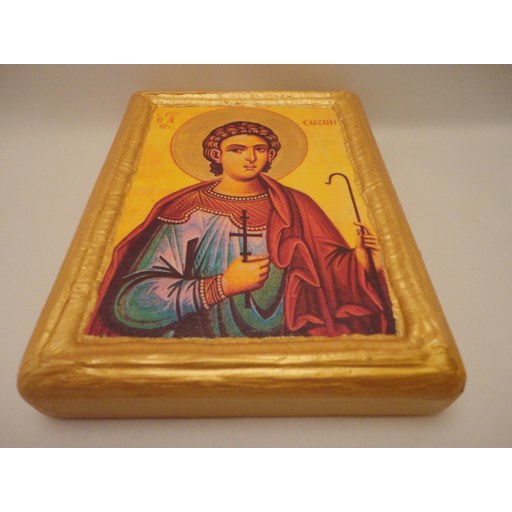
Sozon was never a bishop, patriarch, or monk, and no reliable source records a spouse or children. Veneration is ancient and liturgical rather than the product of a medieval papal canonization. He is kept on 7 September in the Byzantine calendar and appears on the same date in some Western martyrologies. Icons in the Greek and Slavic worlds often show him as a youthful shepherd or as a martyr holding a cross. Specific later patronages of cities, trades, or illnesses are not firmly established in the early sources. Beyond the synaxarion outline, the historian can say little that is independently verifiable; the narrative remains that of a typical early-fourth-century martyr as remembered in the churches of the East.