Speusippus, Eleusippus and Melapsippus is a saint of the Catholic Church. Speusippus, Eleusippus and Melapsippus's feast day is celebrated on 17 January. Speusippus, Eleusippus and Melapsippus is the patron saint of Langres.
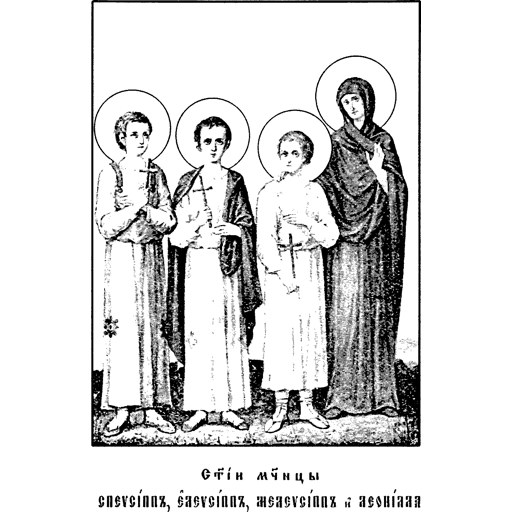
Unknown authorUnknown author
License: Public domain
Speusippus, Eleusippus and Melapsippus
Saint- Feast Day
- 17 January
- Gender
- male
- Church
- Catholic
Places
Roles & Family
Patronage
Langres
Biography
Speusippus, Eleusippus and Melapsippus (the last also spelled Meleusippus) are a group of Christian martyrs commemorated jointly in both Western and Eastern calendars. Tradition describes them as brothers, and frequently as triplets born at a single birth, who suffered during the second century, in the reign of the emperor Marcus Aurelius. The earliest surviving narrative of their passion is legendary in character and exists in Greek and Latin recensions that do not agree in every particular. In the form of the story that circulated in the East, the brothers belonged to Cappadocia. Their grandmother Leonilla, already a Christian, converted them from paganism; a sister named Neonilla (or Junilla) is often included among the converts. A writer named Turbon is credited in the legend with having recorded their acts.
According to this Passio, the newly converted brothers manifested their faith by destroying idols. They were arrested and brought before a Roman governor, who ordered them to sacrifice to the gods. Upon their refusal they were tortured—later accounts speak of scourging, exposure to fire, and other torments—and were at last beheaded. Leonilla and Neonilla were put to death as well. The Roman Martyrology, following the medieval tradition of the church of Langres, commemorates Speusippus, Eleusippus and Meleusippus on 17 January and locates their martyrdom at Langres in Gaul, together with their grandmother Leonilla, under Marcus Aurelius. Critical hagiography generally holds that the Cappadocian setting is the original one and that the association with Langres arose from a subsequent translation of relics to that city, a common pattern in the movement of Eastern cults into Gaul in late antiquity.
The relics attributed to the three brothers were enshrined in the territory of Langres, in what is now northeastern France. Around their sanctuary there developed the settlement known as Saints-Geosmes, a name derived from the Latin Sancti Gemini (“the holy twins”), even though the legend speaks of three brothers rather than two. They became closely identified with the city and diocese of Langres and are regarded as among its patrons. Their names entered Western martyrologies through this local cult, while Greek synaxaria continued to remember them as Cappadocian martyrs. The feast on 17 January remains the principal date of commemoration in the Roman tradition.
Beyond the existence of an early and geographically widespread cult, almost nothing about the brothers can be established by strictly historical methods. They do not appear in contemporary historians such as Eusebius, and the Acts that bear their names are not regarded as authentic records of a trial. The conventional date of 175 that is often assigned to their death is a later inference from the mention of Marcus Aurelius rather than a documented year. Their standing in the calendar rests on ancient veneration rather than on a formal process of canonization. They are honored as second-century martyrs and as patrons of Langres, and their memory is preserved in the toponym Saints-Geosmes and in the liturgical books of East and West.