St Goban is a saint of the Catholic Church (d. 670). St Goban's feast day is celebrated on 20 June. St Goban is the patron saint of Saint-Gobain.
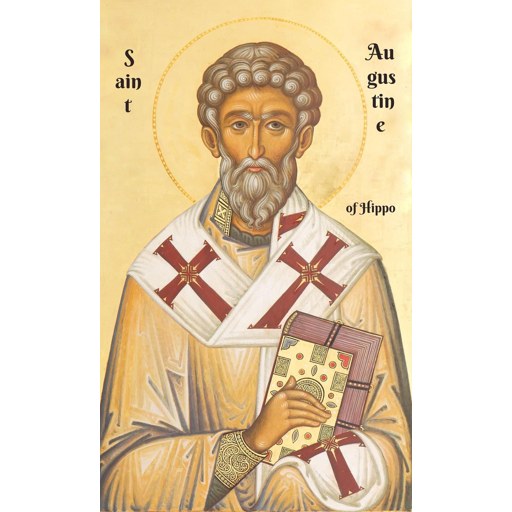
https://www.pinterest.com/ideas/st-augustine-of-hippo-icon/958399913345/
License: unknown
St Goban
Saint- Life Span
- d. 670
- Feast Day
- 20 June
- Gender
- male
- Church
- Catholic
Places
Roles & Family
Patronage
Saint-Gobain
Biography
Saint Goban, also known as Gobain, Gobban, or Gobanus, was a seventh-century Irish monk, priest, and missionary remembered as a companion of Saint Fursey and as a hermit who suffered martyrdom in northern Gaul. Almost nothing can be verified about his birth or youth. Tradition places his origin in Ireland, and later accounts sometimes describe him as coming from a family of rank, but no contemporary record of his parentage, birthplace, or date of birth survives. He belongs to the generation of Irish peregrini who left Ireland in the seventh century to live under monastic discipline abroad and to preach among the English and the Franks.
He is associated in the sources with Saint Fursey (Fursa), the Irish abbot whose visions were widely known in the early Middle Ages. Fursey left Ireland, established a monastery at Cnobheresburg in East Anglia (usually identified with Burgh Castle in Norfolk) under King Sigeberht, and later crossed to the Continent, where he founded a monastery at Lagny and died about 650, being buried at Péronne. Goban is named among those who accompanied Fursey on these journeys. After Fursey's death, Goban did not remain at Péronne or Lagny. According to the traditional narrative, he withdrew into the forest of Voas (Forêt de Voas) in the diocese of Laon, in the region that is now the Aisne department of Picardy. There he built a hermitage and an oratory and lived in solitude and austerity.
Hagiographical tradition states that he was discovered by barbarians and beheaded. The killers are variously described as vandals, pagans, or marauders; their exact identity cannot be established. The year commonly assigned to his martyrdom is 670, though this date is conventional rather than independently documented in a contemporary chronicle. A settlement formed around the site of his cell and tomb and took his name; it is the modern commune of Saint-Gobain. His relics were venerated in the local church. The cult remained primarily regional, centred on Picardy, while Irish martyrological tradition also preserved his memory among the many Irish monks who laboured in Francia.
Saint Goban is commemorated on 20 June, the date given in the Roman Martyrology, which records him as a priest and martyr in the forest of Voas in the territory of Laon, an Irishman who led a solitary life in France and was slain by barbarians. He should be distinguished from other Irish saints of similar name, including Gobban, an abbot connected with Old Leighlin, and the female saint Gobnait of Ballyvourney. No early Life of Goban is extant, and the surviving notices are brief. What can be said with confidence is that he represents the well-attested movement of seventh-century Irish monastic missionaries on the Continent, and that a durable local cult at Saint-Gobain preserved his name even where the details of his biography have been lost.