Stanisław Kazimierczyk is a saint of the Catholic Church (1433 - 1489). Stanisław Kazimierczyk's feast day is celebrated on 5 May.
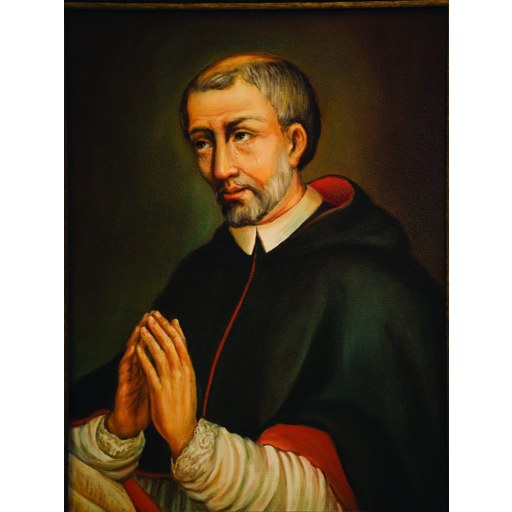
Unknown authorUnknown author
License: Public domain
Stanisław Kazimierczyk
Saint- Life Span
- 1433 - 1489 (age 56)
- Feast Day
- 5 May
- Gender
- male
- Church
- Catholic
Places
Relics & Where to Venerate
Location unknown
The bodily remains of Stanisław Kazimierczyk are a first-class relic. Venerated at Kraków.
Roles & Family
Religious Information
Canonization
Biography
Stanisław Kazimierczyk was born Stanisław Sołtys on 27 September 1433 in Kazimierz, a royal town adjoining Kraków in the Kingdom of Poland. His parents were Maciej Sołtys and Jadwiga, members of the local burgher community. He received his early education at the parish school of the Church of Corpus Christi in Kazimierz and then studied philosophy and theology at the University of Kraków. In 1456 he entered the house of the Canons Regular of the Lateran attached to Corpus Christi, remaining in that community for the rest of his life.
Kazimierz in the later fifteenth century was a chartered urban center under the Jagiellonian kings, with a substantial parish and a well-established house of Lateran canons. Kazimierczyk's vocation thus combined university learning with the common life and pastoral duties of canons regular rather than with a secular clerical career or a mendicant order. After profession and ordination he served as preacher, confessor, novice master, and prior. For roughly three decades he was known in Kazimierz and nearby Kraków as a preacher and as a priest much occupied with hearing confessions.
Traditional accounts, later gathered for his cause, present him as a man of Eucharistic and Marian devotion, personal austerity, and practical charity toward the poor and the sick. Medieval records of his daily life are sparse, and much of the detail in later vitae is hagiographical in character; the core facts of his origin, education, religious profession, offices, and death are nonetheless consistent in the tradition of his order and in the modern processes. He died in the Corpus Christi monastery on 3 May 1489 and was buried in the church.
Veneration at his tomb began after his death, and Corpus Christi became a local pilgrimage church associated with reported healings and other favors. The cause for beatification was taken up in modern times. Pope John Paul II beatified him on 18 April 1993 in Saint Peter's Square in Rome. Pope Benedict XVI canonized him on 17 October 2010, likewise in Saint Peter's Square. The Catholic Church observes his feast on 5 May. His relics are kept in the Basilica of Corpus Christi in the Kazimierz district of Kraków, which remains the principal place of his cult.