Stanislaus Kostka is a saint of the Catholic Church (1550 - 1568). Stanislaus Kostka's feast day is celebrated on 13 November. Stanislaus Kostka is the patron saint of Poland;Jesuit novices;students;young people;last sacraments;heart palpitations.
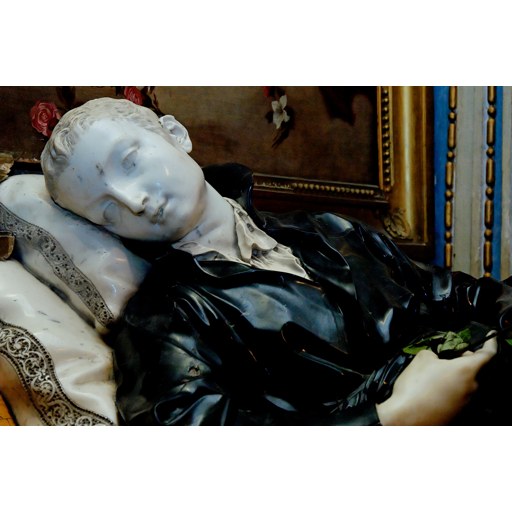
Pierre Le Gros the Younger
License: Public domain
Stanislaus Kostka
Saint- Life Span
- 1550 - 1568 (age 18)
- Feast Day
- 13 November
- Gender
- male
- Church
- Catholic
Places


Relics & Where to Venerate
Location unknown
The bodily remains of Stanislaus Kostka are a first-class relic. Venerated at Sant'Andrea al Quirinale.
Roles & Family
Religious Information
Patronage
Poland;Jesuit novices;students;young people;last sacraments;heart palpitations
Canonization
Biography
Stanislaus Kostka (Polish: Stanisław Kostka) was born in 1550 at Rostkowo in Mazovia, in the Kingdom of Poland. He was a son of the nobleman Jan Kostka, castellan of Zakroczym and a senator, and of Małgorzata Kryska of the Kryski family. Belonging to the Polish szlachta, he received a Catholic upbringing and, about 1564, was sent with his elder brother Paweł to study at the Jesuit college in Vienna. In the imperial capital he proved an able student and a youth of marked piety. After the Jesuits were obliged to give up their boarding house, the brothers lodged in a private residence whose owner was a Lutheran. The contrast between Stanislaus’s religious seriousness and the more worldly habits of his brother and their tutor produced friction that later accounts describe as harsh and even violent.
In late 1566 Stanislaus fell gravely ill. Traditional hagiography states that, because a Catholic priest was not permitted to enter the Lutheran household, he could not receive the Eucharist, and that Saint Barbara, a saint to whom he was devoted, appeared with two angels and brought him Communion. The same tradition holds that the Virgin Mary appeared to him, placed the Child Jesus in his arms, and told him to enter the Society of Jesus. Independent of the visionary details, it is historically clear that he thereafter sought admission to the Jesuits. The provincial in Vienna declined to receive him without the consent of his powerful family, which was withheld. In August 1567 Stanislaus left Vienna on foot, traveling into southern Germany. At Dillingen he was examined and accepted in principle by Peter Canisius, provincial of Upper Germany, who after a short period sent him on to Rome with companions.
He reached Rome in October 1567 and was received into the Jesuit novitiate by the Superior General, Francis Borgia. The date of his entry is commonly given as 28 October 1567. For the next ten months he lived the ordinary life of a novice at the Roman College: prayer, menial work, study, and the Spiritual Exercises of Ignatius of Loyola. Those who knew him recalled humility, obedience, cheerfulness, and a particular devotion to the Blessed Sacrament and to the Mother of God. He did not live to take vows. In early August 1568 he spoke of dying soon. A fever, frequently identified by later writers as malaria, struck him about 10 August. He received the last sacraments and died in the morning of 15 August 1568, the feast of the Assumption of Mary, at the age of seventeen.
His remains were buried in Rome and are now venerated in the church of Sant'Andrea al Quirinale. Devotion to him spread rapidly within the Society of Jesus and in Poland, where he came to be regarded as a model of youthful holiness. Pope Paul V beatified him in 1605. Pope Benedict XIII canonized him on 31 December 1726, in the same ceremony as Aloysius Gonzaga. The Catholic Church observes his feast on 13 November. He is honored as a patron saint of Poland, of Jesuit novices, of students and young people, and is invoked for a holy death and, in popular devotion, by those suffering from heart ailments.