Stefan Wyszyński is a venerable of the Catholic Church (1901 - 1981). Stefan Wyszyński's feast day is celebrated on 28 May.
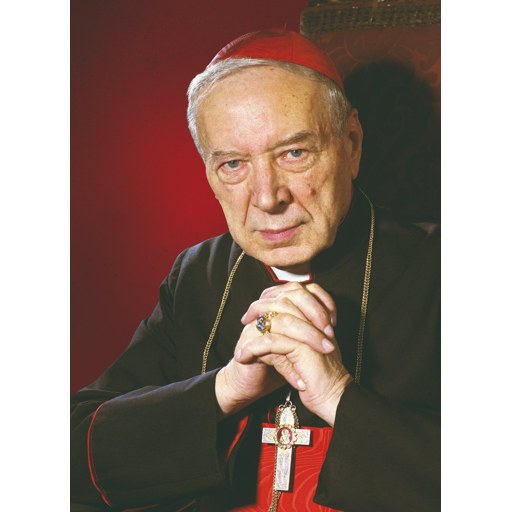
Janusz Trocha
License: Public domain
Stefan Wyszyński
Venerable- Life Span
- 1901 - 1981 (age 80)
- Feast Day
- 28 May
- Gender
- male
- Church
- Catholic
Places
Relics & Where to Venerate
Location unknown
The bodily remains of Stefan Wyszyński are a first-class relic. Venerated at St. John's Archcathedral.
Roles & Family
Canonization
Biography
Stefan Wyszyński was born on 3 August 1901 in the village of Zuzela on the Bug River, in the Łomża Governorate of Russian-ruled Congress Poland. His father, Stanisław Wyszyński, was a church organist and village official; his mother, Julianna née Karp, died when Stefan was nine. After secondary schooling he entered the diocesan seminary at Włocławek and was ordained a priest on 3 August 1924, his twenty-third birthday. He then studied at the Catholic University of Lublin, receiving a doctorate in canon law in 1929 with a dissertation on the respective rights of the family, the Church, and the state regarding schools. In the 1930s he taught canon law and Catholic social teaching at the Włocławek seminary, edited Catholic periodicals, and became known as a specialist in the Church’s social doctrine.
During the German occupation of Poland he went into hiding after the Włocławek seminary was closed and many clergy were arrested. He served as a chaplain to the Polish underground, including Home Army circles, and as chaplain to a hospital for insurgents at Laski near Warsaw during the 1944 Warsaw Uprising. After the war he returned to Włocławek as rector of the reopened seminary. In March 1946 Pope Pius XII appointed him Bishop of Lublin; he was consecrated in May of that year. In November 1948 he was named Archbishop of Gniezno and Warsaw and thus Primate of Poland, becoming the leading figure of the Catholic Church in a country under Stalinist communist rule.
Wyszyński at first sought a limited accommodation with the communist authorities in order to keep pastoral life functioning, including a 1950 agreement, but the regime’s campaign against the Church intensified. In 1953, after he refused to condemn imprisoned bishops and rejected a loyalty demand that would have given the state control over ecclesiastical appointments, he was arrested on 25 September 1953. He was interned without trial for three years at Rywałd, Stoczek Klasztorny, Prudnik, and finally the convent at Komańcza. While detained he drafted the Jasna Góra Vows of the Nation, proclaimed at the Jasna Góra shrine in 1956. Released in October 1956 during the Polish October thaw, he resumed leadership of the Church and launched the Great Novena of 1957–1966, a nine-year program of pastoral renewal preparing for the millennium of Poland’s baptism in 966. He became widely known as the Primate of the Millennium.
Pius XII created him a cardinal in 1953, though he could receive the red hat only in 1957, from Pope John XXIII. He took part in the Second Vatican Council and worked closely with Karol Wojtyła, Archbishop of Kraków, who was elected pope in 1978 as John Paul II. Wyszyński’s long defense of the Church’s independence was widely regarded as having prepared the ground for that pontificate and for the later Solidarity movement. He died in Warsaw on 28 May 1981, weeks after the assassination attempt on John Paul II, and was buried in St. John’s Archcathedral in Warsaw. Pope Francis beatified him on 12 September 2021; his liturgical memorial is kept on 28 May.