Stefano Maconi is a blessed of the Catholic Church (d. 1424).
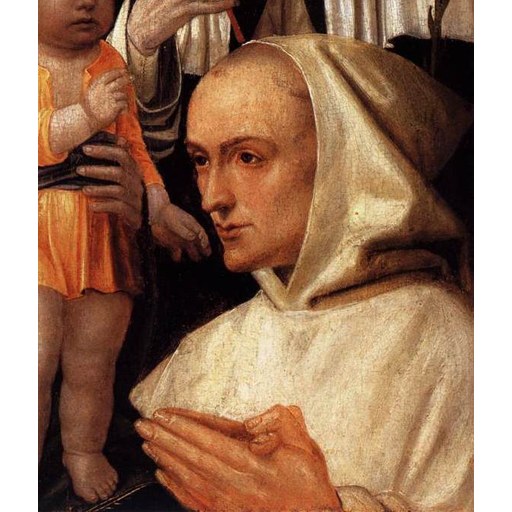
Ambrogio Bergognone
License: Public domain
Stefano Maconi
Blessed- Life Span
- d. 1424
- Gender
- male
- Church
- Catholic
Places
Roles & Family
Religious Information
Biography
Stefano Maconi was a fourteenth-century Sienese who became one of the closest lay disciples of Saint Catherine of Siena and, after her death, a Carthusian monk and prior. He was born in Siena in the middle of the fourteenth century into a family of notable civic position; contemporary and near-contemporary sources name his father as Corrado Maconi. He received an education appropriate to public life in the Republic of Siena. In the later 1370s he came under the influence of Catherine of Siena, whose circle included secretaries, copyists, and spiritual sons from the Sienese patriciate. Maconi served her as a scribe and correspondent. Catherine wrote to him on conversion, humility, and the choice of a religious order, and she consistently pointed him toward the Carthusians, whose eremitical and liturgical life she judged suited to his temperament.
Catherine died in Rome in 1380. The following year Maconi entered the Carthusian monastery of Pontignano, near Siena, thus fulfilling the direction she had given him. He was later transferred to the Carthusian houses of Lombardy. He served as prior of the charterhouse of Milan and, for a prolonged period, as prior of the Certosa of Pavia, a major Visconti foundation. As prior he governed communities bound to the Statutes of the Carthusian Order—solitude in cell, conventual liturgy, and strict enclosure—while also managing the temporal affairs of wealthy and architecturally ambitious monasteries. He acted at times as a visitor within the Italian province of the Order.
Maconi never abandoned his role as a guardian of Catherine’s writings. He collected her letters, arranged them, and promoted their circulation among Carthusians and others. This editorial and archival work made him an important early witness in the documentary tradition that supported Catherine’s cult in Italy and that fed into the canonization process concluded in 1461. He is not known to have been married and had no children; from 1381 until his death he lived under Carthusian vows. He was neither pope nor patriarch, and he has not been the object of a formal papal canonization or beatification, nor of a universally observed feast day.
He died in the early fifteenth century, the year 1424 being the date given in standard biographical accounts, at the Certosa of Pavia. His memory is preserved chiefly in studies of Catherine of Siena and in the institutional history of the Carthusian Order in Tuscany and Lombardy.