Stephen Harding is a saint of the Catholic Church (d. 1134). Stephen Harding's feast day is celebrated on 17 April.
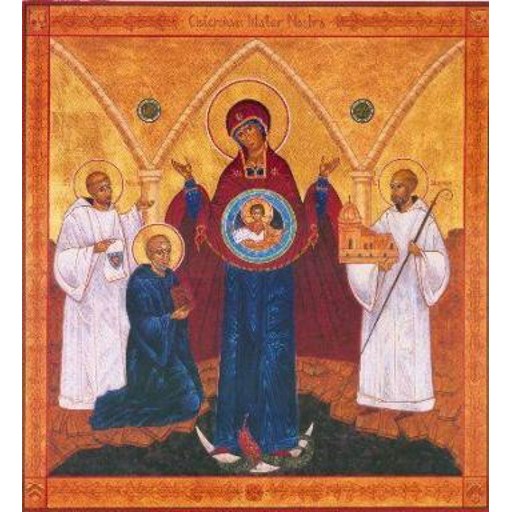
License: Public domain
Stephen Harding
Saint- Life Span
- d. 1134
- Feast Day
- 17 April
- Gender
- male
- Church
- Catholic
Places
Roles & Family
Religious Information
Biography
Stephen Harding was an English monk and abbot who became one of the principal founders of the Cistercian Order. He was born in the mid-eleventh century at Sherborne in Dorset, in the Kingdom of England, into a family of Anglo-Saxon nobility. As a youth he received his education at the Benedictine abbey of Sherborne. After leaving England he is reported to have spent time in Scotland and then to have pursued studies in France, including at Paris, before making a pilgrimage to Rome. Upon returning from Italy he entered the Benedictine monastery of Molesme in Burgundy, a house founded by Robert of Molesme that sought a stricter observance of the Rule of Saint Benedict.
Dissatisfied with what they regarded as a relaxation of monastic discipline at Molesme, Robert, Prior Alberic, and Stephen Harding, together with a group of like-minded monks, obtained permission to depart and in 1098 established a new monastery in a remote wooded site at Cîteaux, in the diocese of Chalon-sur-Saône in Burgundy. This foundation, called the New Monastery, became the mother house of the Cistercian Order. Robert was soon required to return to Molesme as abbot, and Alberic succeeded him at Cîteaux. After Alberic's death in 1108 or 1109, Stephen Harding was elected third abbot of Cîteaux. Under his lengthy abbacy the small and struggling community was transformed into the center of a rapidly expanding religious order.
Stephen Harding is credited with giving the Cistercians their distinctive constitutional structure. He composed the Carta Caritatis (Charter of Charity), which regulated relations among Cistercian houses, instituted the annual General Chapter at Cîteaux, and provided for regular visitations of daughter abbeys by their mother houses, thereby creating an organized monastic federation while preserving the autonomy of each community. Around 1112 a young Burgundian nobleman named Bernard entered Cîteaux with some thirty companions; their arrival proved a turning point. Within a few years Stephen sent out the four elder daughter houses of Cîteaux—La Ferté, Pontigny, Clairvaux, and Morimond—from which the order spread across western Europe. He also promoted liturgical and textual reforms, including the production of a carefully corrected Bible known as the Bible of Stephen Harding, and insisted on simplicity in architecture, clothing, and chant in keeping with a literal reading of the Benedictine Rule.
In his final years Stephen's health failed. He resigned the abbacy in 1133 and died at Cîteaux on 28 March 1134. He was buried at the abbey. Although he was never the object of a formal papal canonization of the later medieval type, he was venerated as a saint from an early period, especially among Cistercians, and his feast has traditionally been kept on 17 April. Together with Robert of Molesme and Alberic of Cîteaux he is honored as a founder of the Cistercian Order, which became one of the most influential monastic movements of the High Middle Ages.