Stephen I of Hungary is a saint of the Catholic Church (d. 1038). Stephen I of Hungary's feast day is celebrated on 16 August. Stephen I of Hungary is the patron saint of Hungary;kings;masons;stonecutters;bricklayers;dying children.
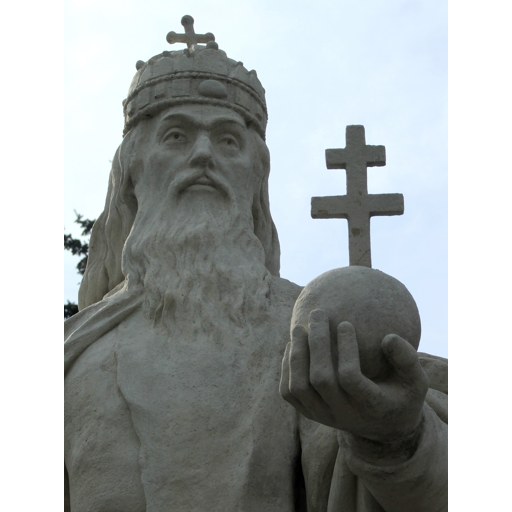
hu:User:Villy
License: Public domain
Stephen I of Hungary
Saint- Life Span
- d. 1038
- Feast Day
- 16 August
- Gender
- male
- Church
- Catholic
Places


Relics & Where to Venerate
Location unknown
The bodily remains of Stephen I of Hungary are a first-class relic. Venerated at Székesfehérvár.
Roles & Family
Religious Information
Patronage
Hungary;kings;masons;stonecutters;bricklayers;dying children
Canonization
Biography
Stephen I of Hungary, originally named Vajk, was born in the late tenth century, most probably at Esztergom in the Hungarian principality, as the son of Grand Prince Géza of the Árpád dynasty and his wife Sarolt, a daughter of the Gyula of Transylvania. Géza had already initiated contacts with Christian powers and invited missionaries, and Stephen was baptized in his youth, receiving the name of the protomartyr. Near-contemporary hagiographical lives, composed after his canonization, present him as destined from childhood for the Christian transformation of his people, though they must be read with caution as historical sources. Designated by his father as heir in preference to the traditional senior agnate, Stephen was associated with the Latin Christian orientation of the court.
After Géza’s death in 997, Stephen’s succession was challenged by Koppány, a cousin who invoked pagan custom and sought both the throne and marriage to the widowed Sarolt. Stephen, supported by German warriors who had come with his wife Gisela of Bavaria, defeated Koppány in battle near Veszprém. The rebel’s quartered body was displayed at the gates of major forts. This victory secured Stephen’s authority in the western parts of the Carpathian Basin and enabled him to proceed with the conversion and administrative unification of the Magyars and allied Kabar tribes.
Stephen was crowned king in 1000 or 1001 with a crown dispatched by Pope Sylvester II, an act that established the independent Christian Kingdom of Hungary and placed it within the orbit of Latin Christendom while preserving its political autonomy from the Holy Roman Empire. He organized the church by founding the archbishopric of Esztergom and a number of suffragan dioceses, endowed Benedictine houses such as Pannonhalma, and issued legislative codes that mandated Christian marriage, the observance of Sundays and feast days, the payment of tithes, and the suppression of pagan rites. Territorially he replaced tribal structures with royal counties governed by appointed ispáns. He conducted campaigns to bring the eastern regions under control and maintained a generally stable foreign policy, marrying his family into German and other dynasties.
Gisela bore Stephen several children, but only their son Emeric lived to maturity. Emeric was trained as co-ruler and heir yet died in 1031 from injuries received in a hunting accident. Left without a direct male heir, Stephen designated his nephew Peter Orseolo of Venice as successor, a decision that later produced conflict. In his last years the king suffered from illness. He died on 15 August 1038 and was buried in the basilica of the Virgin Mary that he had founded at Székesfehérvár, which became the traditional coronation and burial church of Hungarian kings.
Stephen was canonized in 1083 when King Ladislaus I, with the authorization of Pope Gregory VII, had his relics elevated together with those of Emeric and Bishop Gerard. He became the foremost patron saint of Hungary. His incorrupt right hand is preserved as a national relic. In the Roman calendar his feast is 16 August; in Hungary 20 August is both a liturgical commemoration and a national holiday marking the foundation of the state. Stephen is venerated as the apostle of the Hungarians and the founder of the medieval Hungarian kingdom.