Stephen Kim Sou-hwan is a servant of god of the Catholic Church (1922 - 2009).
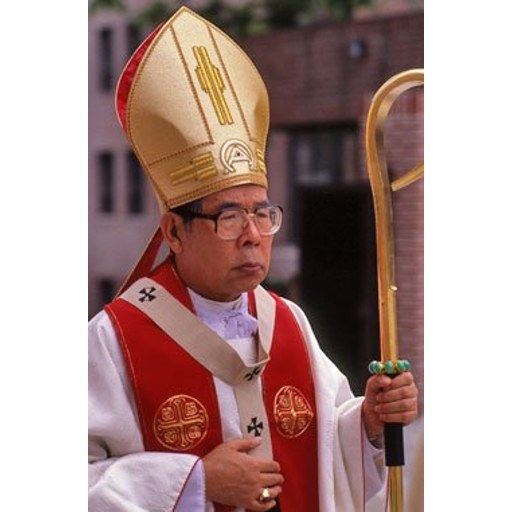
Unknown Author
License: Public domain
Stephen Kim Sou-hwan
Servant of God- Life Span
- 1922 - 2009 (age 87)
- Gender
- male
- Church
- Catholic
Places
Relics & Where to Venerate
Location unknown
The bodily remains of Stephen Kim Sou-hwan are a first-class relic. Venerated at Yongin Catholic Park Cemetery.
Roles & Family
Biography
Stephen Kim Sou-hwan was born on 8 May 1922 in Daegu, in Korea then under Japanese colonial rule, and received the baptismal name Stephen. He grew up in a Catholic family at a time when the Korean Church was still relatively small and often constrained by colonial and wartime conditions. After seminary formation he was ordained a priest for the Diocese of Daegu on 15 September 1951, during the Korean War. Following early pastoral work he was sent to Europe and studied sociology at the University of Münster in Germany for several years in the later 1950s and early 1960s. That academic training, uncommon among Korean clergy of his generation, strengthened a lasting concern for social questions, labor, and the lives of ordinary people.
In 1966 he was appointed the first bishop of the newly erected Diocese of Masan. In 1968 Pope Paul VI named him Archbishop of Seoul, the principal see of the country, and in April 1969 created him a cardinal, the first Korean to sit in the College of Cardinals and one of the youngest cardinals of that period. He was given the Roman title of San Felice da Cantalice a Centocelle. As archbishop he also served as apostolic administrator of Pyongyang, a pastoral sign of concern for Catholics in North Korea after the division of the peninsula. He led the Catholic Bishops' Conference of Korea for many years and became the most widely recognized face of Korean Catholicism at home and abroad. He took part in the two conclaves of 1978 that elected John Paul I and John Paul II.
During the authoritarian decades associated with Park Chung-hee and Chun Doo-hwan, Cardinal Kim was among South Korea's most prominent critics of dictatorship and human-rights abuses. Myeongdong Cathedral in central Seoul, under his authority, repeatedly served as a refuge for student activists, labor organizers, and political dissidents. He spoke against the Yushin system, condemned torture and unjust imprisonment, and in 1987 his public stance formed part of the pressure surrounding the June Democratic Uprising and the move toward direct presidential elections. He also addressed poverty, capital punishment, and the need for reconciliation on the divided peninsula, presenting the Church as an advocate for democracy and the marginalized rather than as a purely private spiritual body.
Kim resigned the Archdiocese of Seoul in 1998 after reaching the ordinary retirement age for bishops and spent his later years in a simpler routine, remaining a respected elder in Korean public life. He died in Seoul on 16 February 2009. His funeral at Myeongdong Cathedral drew large numbers of clergy, public figures, and ordinary citizens, reflecting a stature that extended well beyond the Catholic community. He has not been beatified or canonized. His historical importance rests on his long pastoral leadership of the Seoul Church and on his role as a moral authority during South Korea's late-twentieth-century struggle for democracy.