Stephen the Younger is a saint of the Catholic Church (d. 764). Stephen the Younger's feast day is celebrated on 28 November.
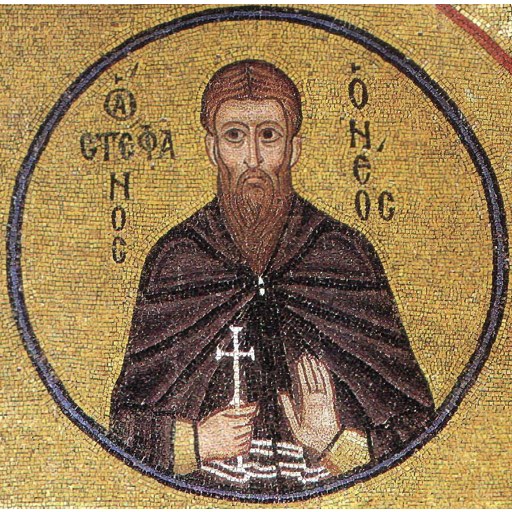
AnonymousUnknown author
License: Public domain
Stephen the Younger
Saint- Life Span
- d. 764
- Feast Day
- 28 November
- Gender
- male
- Church
- Catholic
Places
Roles & Family
Biography
Stephen the Younger was an eighth-century Byzantine monk and martyr, remembered as one of the principal monastic opponents of imperial iconoclasm under Emperor Constantine V. He was born in Constantinople, the capital of the Byzantine Empire, in the early eighth century, during or shortly after the brief reign of Emperor Anastasios II. Surviving sources do not fix his birth to a single undisputed year; later tradition has offered both 713 and 715. The principal narrative of his life, composed in the early ninth century by a deacon also named Stephen, names his mother as Anna and presents his family as pious and of respectable standing in the city. As a youth he embraced the monastic life and entered the community on Mount Auxentios, a prominent monastic mountain in Bithynia, across the Bosporus from Constantinople near Chalcedon. There he was formed under the abbot John and in time became hegoumenos of the monastery himself.
Mount Auxentios had long been a center of eremitic and coenobitic life. Under Stephen’s leadership the monastery attracted disciples and gained a reputation for ascetic rigor and for loyalty to the traditional veneration of icons. In the middle decades of the eighth century this stance placed the community in direct conflict with imperial policy. Constantine V, who reigned from 741 to 775, was a determined iconoclast. He convened the Council of Hieria in 754, which condemned the making and veneration of religious images and anathematized leading iconophile figures. Monastic institutions were particular targets of the emperor’s campaign, both because monks were among the most vocal defenders of icons and because Constantine sought to curtail monastic wealth and influence. Stephen became known as a steadfast iconophile and a critic of the new doctrine.
Hagiographical tradition describes a prolonged confrontation between the monk and the emperor. Constantine is said to have summoned Stephen, attempted to win him over, and, failing that, to have resorted to imprisonment, public denunciation, and efforts to blacken his moral reputation. Whether every episode in the ninth-century Life can be taken as literal history is doubtful; the text is a work of iconophile advocacy written after the first restoration of icons, and it employs conventional motifs of the holy man resisting a tyrannical ruler. What is not in serious dispute is that Stephen refused to accept iconoclasm, that he was regarded as a leader of monastic resistance, and that he died a violent death in Constantinople in the mid-760s, traditionally on 28 November 764. Accounts of the martyrdom describe him being seized by a crowd or by agents of the emperor and beaten to death in the streets of the capital.
After his death Stephen was rapidly honored as a martyr by those who rejected iconoclasm. His cult was promoted during the iconophile reaction under Empress Irene, and the Life written by Stephen the Deacon around 809 became the foundation of his later reputation. Modern historians, while using that Life as a source for the social and religious history of eighth-century Constantinople and Bithynia, treat its narrative with critical caution and do not accept all of its dialogues and miracles as historical. Stephen the Younger is venerated as a saint in the Eastern Orthodox Church, which commemorates him on 28 November. He is styled the Younger or the New to distinguish him from Saint Stephen the Protomartyr. He did not hold episcopal or patriarchal office and lived as a celibate monk; no spouse or children are recorded. Specific later patronages attached to his name are not well documented in the major historical and liturgical sources.