Sulpicius the Pious is a saint of the Catholic Church (d. 647). Sulpicius the Pious's feast day is celebrated on 17 January.
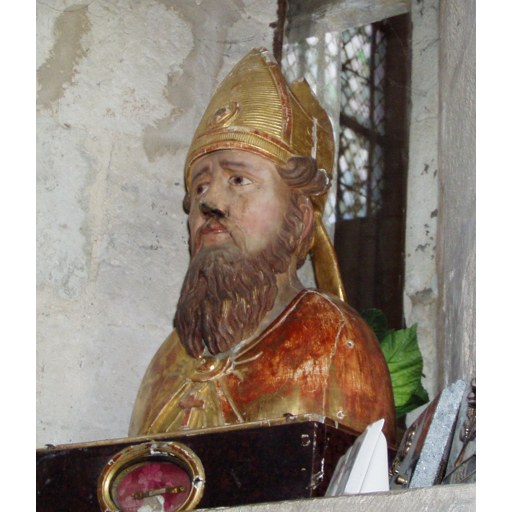
Accrochoc
License: CC BY-SA 3.0
Sulpicius the Pious
Saint- Life Span
- d. 647
- Feast Day
- 17 January
- Gender
- male
- Church
- Catholic
Places
Roles & Family
Biography
Sulpicius the Pious, known in Latin as Sulpicius Pius and often numbered Sulpicius II of Bourges to distinguish him from an earlier bishop of that see, was a Merovingian-era bishop of central Gaul. He is not to be confused with the better-known Sulpicius Severus, the late-fourth- and early-fifth-century writer of the Life of Saint Martin. Sulpicius the Pious was born at Vatan in Berry, in what is now the department of Indre in central France, into a family of high social rank. As a youth he was placed at the court of the Frankish king Chlothar II, a usual path for aristocratic young men who might enter either royal service or the higher clergy. Tradition already credited him there with seriousness, learning, and charity. Leaving the court, he attached himself to the church of Bourges. Bishop Austregisilus of Bourges (Saint Outrille) ordained him and made him archdeacon, in which office he became known for preaching, care of the poor, and administrative competence.
When Austregisilus died, around 624, the clergy and people of Bourges elected Sulpicius bishop. He governed the diocese for more than two decades, through the later years of Chlothar II, the reign of Dagobert I, and into the time of Clovis II. Accounts of his episcopate present a pastor who combined personal austerity with public firmness. He is said to have resisted oppressive royal officials and local magnates who burdened the people of Berry with unjust exactions, and to have used his standing at court to defend the liberties of his church. He took part in the Council of Clichy in 627, one of the more important Frankish synods of the early seventh century. Hagiographical tradition emphasizes hospitality, washing the feet of the poor, and the foundation or endowment of religious houses, though precise institutional details are not always recoverable from the surviving texts. He remained a diocesan bishop rather than a member of a monastic order.
Sulpicius died in Bourges on 17 January, in a year given by most modern reference works as 647, though some older authorities preferred 644. He was buried in Bourges. A Latin Life, the Vita Sancti Sulpicii, was composed within about a generation of his death and circulated in Frankish Gaul; it is the principal narrative source for his career. Veneration began soon afterward, and his feast was entered in martyrologies on 17 January. The Roman Martyrology commemorates him as bishop of Bourges, surnamed the Pious. Because he belongs to the era before the later centralized processes of beatification and canonization, no individual pope is recorded as having canonized him; his cult is of the pre-congregation type, grounded in local and liturgical reception.
In later centuries his name spread far beyond Berry, above all through the dedication of the church of Saint-Sulpice in Paris, which became one of the largest and most influential parishes of the French capital. In the 1640s Jean-Jacques Olier, pastor of that church, founded the Society of the Priests of Saint Sulpice (the Sulpicians), a community devoted to the education of diocesan clergy. The Sulpicians took the seventh-century bishop as their titular patron and carried his name into seminaries in France, Canada, and the United States. Local devotion continued at Vatan and Bourges. The historical kernel of his life—an aristocratic cleric formed at a Merovingian court, then archdeacon and bishop of a major Gallic see, a participant in conciliar life, and the subject of an early Vita—is reasonably secure. Many miracle stories attached to him belong to the conventional repertoire of seventh-century hagiography and cannot be verified independently.