Sylvius of Toulouse is a saint of the Catholic Church. Sylvius of Toulouse's feast day is celebrated on 31 May.
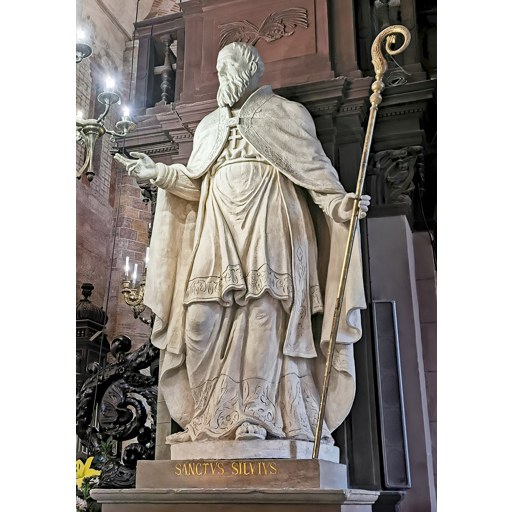
Didier Descouens
License: CC BY-SA 4.0
Sylvius of Toulouse
Saint- Feast Day
- 31 May
- Gender
- male
- Church
- Catholic
Places
Relics & Where to Venerate
Location unknown
The bodily remains of Sylvius of Toulouse are a first-class relic. Venerated at Basilica of St. Sernin.
Roles & Family
Biography
Saint Sylvius of Toulouse, known in the French hagiographical tradition as Saint Selve or Saint Silva (Latin Silvius), was a bishop of the see of Toulouse in southern Gaul in the later fourth century. According to the traditional episcopal catalogues preserved by the church of Toulouse, he was the fourth occupant of that see. Those lists place him after Saint Saturninus, the missionary founder martyred in the mid-third century, after Saint Honoratus, and after Saint Hilary (Hilarius) of Toulouse. No ancient source records the place or date of his birth, the names of his parents, or the circumstances of his election and consecration. He is known almost exclusively through his position in the succession and through later local tradition concerning the shrine of Saint Saturninus.
The principal deed ascribed to him is his initiative in providing a worthier resting place for the relics of Saint Saturninus, called Saint Sernin in Occitan and French. The ancient Passio of Saturninus recounts that the first bishop was tied to a bull and dragged to his death at Toulouse; his body was later given more honorable burial by subsequent bishops. Medieval and early modern accounts state that Sylvius began the erection of a stone basilica on the site north of the Roman city where the martyr’s tomb was venerated. That building was the distant predecessor of the present Basilica of Saint-Sernin, later one of the great Romanesque churches of Europe and a major station on the pilgrimage roads to Santiago de Compostela. Sylvius did not live to see the work finished.
His successor, Saint Exuperius (French Exupère), who is independently attested in the opening years of the fifth century by letters of Pope Innocent I and of Saint Jerome, completed the church and conducted a solemn translation of Saturninus’s relics into it. The relative chronology of the two bishops implies that Sylvius’s death occurred around the year 400, at the close of the fourth century. Toulouse was then still a Roman provincial capital in Gallia Narbonensis, with a Gallo-Roman population and a Christian community that had passed from the era of intermittent persecution into public life. No writings, conciliar acts, or contemporary inscriptions naming Sylvius have been identified; that silence is typical of many Gallic bishops of his generation.
Devotion to Sylvius as a saint took root in the local church and was registered in martyrologies and in the liturgical calendar of the diocese of Toulouse. His traditional feast day is 31 May. Like other holy bishops of late antiquity, he was venerated by popular and episcopal acclaim long before the papacy reserved formal canonization to itself. He is not known to have belonged to a religious order, and nothing reliable is recorded of any marriage or children. His historical importance lies less in a richly documented personal biography than in his place as a link in the chain of Toulouse’s early bishops and as the initiator of the sanctuary that became the city’s principal pilgrimage church. Modern historical criticism treats the outline of his episcopate as plausible while acknowledging that almost every narrative detail beyond the succession itself rests on later tradition rather than on fourth-century documents.