Symeon of Thessalonica is a saint of the Catholic Church (d. 1429). Symeon of Thessalonica's feast day is celebrated on 15 September.
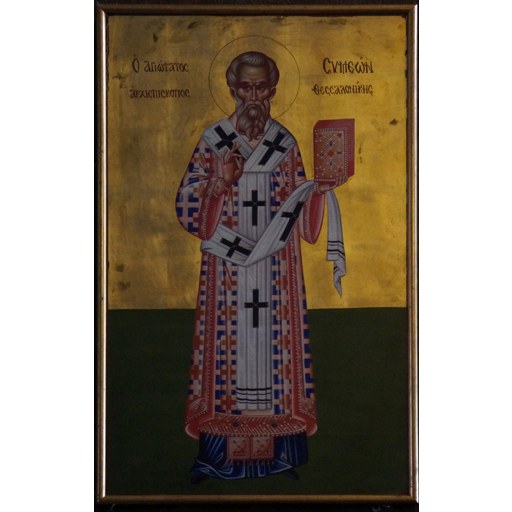
G.Garitan
License: CC BY-SA 4.0
Symeon of Thessalonica
Saint- Life Span
- d. 1429
- Feast Day
- 15 September
- Gender
- male
- Church
- Catholic
Places
Roles & Family
Biography
Symeon of Thessalonica (also called Symeon of Thessaloniki) was a late Byzantine Orthodox theologian, liturgical commentator, and hierarch who served as Archbishop of Thessalonica in the early fifteenth century. He is counted among the last major ecclesiastical writers of the Byzantine world before the fall of Constantinople, and his works are principal witnesses both to Palamite hesychast doctrine and to the actual liturgical practice of a great Byzantine cathedral at the end of the Middle Ages. Almost nothing can be established with certainty about his family, birthplace, or year of birth; surviving sources do not record a verified date of birth, and estimates sometimes found in later reference works are not securely grounded. He is known to have lived as a monk in Constantinople and to have been formed in the hesychast tradition associated with the theology of Gregory Palamas. In 1416 or 1417 he was appointed to the metropolitan throne of Thessalonica, a see of high prestige that was by then impoverished, depopulated, and under constant Ottoman pressure.
His episcopate unfolded during the prolonged Ottoman blockade of the city. In 1423 the civic authorities transferred Thessalonica to the Republic of Venice in the hope of obtaining military protection. Symeon, a convinced Byzantine loyalist, accepted that transfer only with reluctance, yet he remained in the city, continued to celebrate the liturgy, and sought to sustain clergy and laity amid famine, epidemic, and political dependence on a Latin power. He was a determined opponent of union with the Church of Rome, rejecting Latin teaching on the Filioque, papal primacy, and the use of unleavened bread in the Eucharist. His polemical and pastoral writings also address Jews, Muslims, and various Christian groups he regarded as heretical. Throughout these years he presented himself as a guardian of Orthodox doctrine and liturgical custom rather than as a political broker.
Symeon was a prolific author in Greek. His long Dialogue in Christ against All Heresies sets out Orthodox teaching in a question-and-answer form and includes a substantial defence of the Palamite distinction between the divine essence and the uncreated energies. He also composed detailed explanations of the Divine Liturgy, of the church building and its furnishings and vestments, and of the sacraments of baptism, chrismation, Eucharist, ordination, marriage, and unction, together with remarks on the liturgical year and monastic offices. These liturgical treatises are of exceptional value because they describe practice in a major late Byzantine cathedral and interpret that practice in a mystical and typological key. Some of his works later circulated in Slavonic translation in the Orthodox Slavic world. Modern critical study of his corpus, notably the editorial and historical work of David Balfour, has clarified both his bibliography and his usefulness as a source for the last decades of Byzantine Thessalonica.
He died in Thessalonica in September 1429, only months before Ottoman forces under Murad II captured the city in March 1430. The precise place of his burial is not securely identified in the sources commonly cited. The Eastern Orthodox Church venerates him as a saint and commemorates him on 15 September. His later reputation rests less on a cycle of miracle stories than on theological fidelity to the Palamite synthesis, on the richness of his liturgical exposition, and on his steadfastness during the final crisis of Byzantine civic and ecclesiastical life in Thessalonica.