Symeon the Metaphrast is a venerable of the Catholic Church. Symeon the Metaphrast's feast day is celebrated on 9 November.
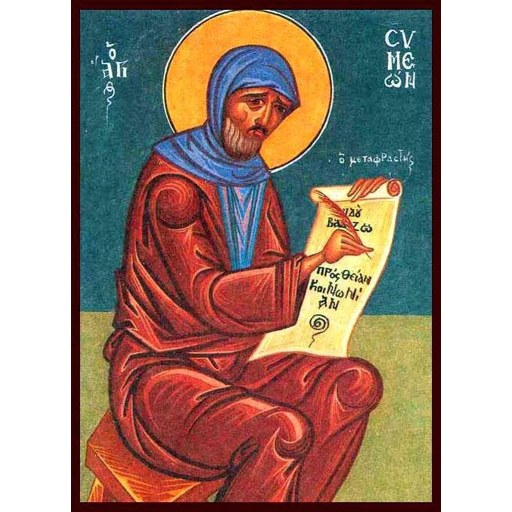
Александр Иванов
License: CC BY-SA 4.0
Symeon the Metaphrast
Venerable- Feast Day
- 9 November
- Gender
- male
- Church
- Catholic
Places
Roles & Family
Biography
Symeon the Metaphrast (Greek: Συμεὼν ὁ Μεταφραστής), also called Symeon Metaphrastes, was a Byzantine hagiographer and high imperial official who flourished in the tenth century. The epithet Metaphrast, from the Greek for paraphrase or rewriting, refers to his principal achievement: a large-scale recension of earlier saints’ lives, recast in a more uniform, Atticizing literary Greek and arranged as a menologion covering the liturgical year. Almost nothing about his life can be dated with precision. The most important early account is an encomium written in the eleventh century by Michael Psellos, who presents Symeon as a man of distinguished family, thorough classical education, and elevated rank in the Constantinopolitan civil service. Later synaxaria and liturgical notices add pious colour but little independently verifiable fact. He is venerated as a saint in the Eastern Orthodox Church.
According to the traditional outline drawn from Psellos and subsequent Byzantine notices, Symeon was born in Constantinople and rose through the imperial bureaucracy. He is often identified with a logothete of the dromos—the official who oversaw the imperial post, aspects of foreign relations, and court ceremonial—serving under mid-to-late tenth-century emperors, a period that includes the reigns of Nikephoros II Phokas, John I Tzimiskes, and the early years of Basil II. Some scholars have further proposed identifying him with Symeon the Logothete, the chronicler, but that identification remains contested and is not universally accepted. Whatever the exact sequence of his titles, he belonged to the educated bureaucratic elite of the capital and had the literary training and archival access required for a systematic rewriting of hagiographical texts. Evidence that he formally became a monk is thin; later tradition sometimes portrays him as withdrawing into a more ascetic life in old age, but contemporary documentation of a monastic profession is lacking.
Symeon’s Menologion, commonly described as containing on the order of 148 to 150 rewritten lives (the precise count varies by manuscript family), became the standard Byzantine collection of saints’ vitae. He did not invent new legends so much as recast older, often popular or stylistically uneven, narratives into a polished, rhetorically consistent form suitable for public reading in churches and monasteries. The collection was copied widely across the Orthodox world, influenced later Slavic and other translations and adaptations, and shaped how Byzantine Christians commemorated the saints for centuries. A number of hymns, prayers, and lesser prose works have also been attributed to him; the authenticity of some of these attributions is uncertain. His work should be distinguished from related court products such as the illustrated Menologion associated with Basil II, which belongs to the same cultural milieu but is not identical with Symeon’s recension.
No reliable contemporary record preserves the exact year of his birth or death, a spouse, children, or a burial place. Older reference works and some liturgical sources give a death date in 987, while many modern historians prefer a cautious placement in the last decades of the tenth century or around the year 1000. His principal feast in the Eastern Orthodox calendar is 9 November; some Western notices have given 28 November. He was never Bishop of Rome, Coptic Pope, or patriarch of an Orthodox or Oriental Orthodox see. His historical importance rests less on the sparse facts of a poorly documented biography than on the literary and liturgical monument of the Metaphrastic menologion, which fixed a high-style corpus of saints’ lives at the centre of Byzantine and later Orthodox devotion.