Syrus is a saint of the Catholic Church. Syrus's feast day is celebrated on 9 December. Syrus is the patron saint of Pavia.
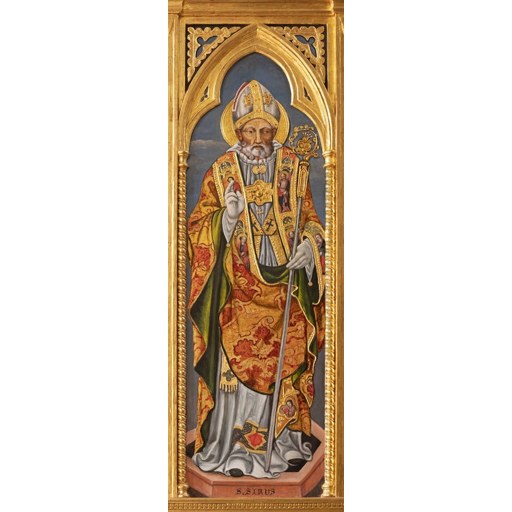
https://dreamstime.com/photos-images/saint-syrus.html
License: unknown
Syrus
Saint- Feast Day
- 9 December
- Gender
- male
- Church
- Catholic
Places
Roles & Family
Patronage
Pavia
Biography
Saint Syrus (Latin Syrus; Italian San Siro) is venerated as the first bishop of Pavia in northern Italy. Almost nothing about his life can be established from contemporary documents. The surviving accounts are medieval hagiographical legends that place him in the apostolic or immediately sub-apostolic age. According to the principal later vitae, he was sent to evangelize the Po valley either by Saint Peter or as a disciple of Saint Hermagoras, the legendary first bishop of Aquileia and purported follower of Saint Mark. In these narratives he preaches across Cisalpine Gaul, performs miracles, converts pagan communities, and organizes the church of Pavia, of which he becomes the first bishop. A companion named Juventius (or Eventius) is often associated with him and is said to have succeeded him in the see. No reliable birth year, birthplace, or death year is preserved; later writers sometimes inferred an eastern origin from his name, but that inference is not historically secure.
Modern historians treat the apostolic dating as legendary. The episcopal list of Pavia and the archaeological and documentary record do not support a first-century bishopric there. It is more plausible that a historical bishop named Syrus lived in a later century—possibly the fourth—and that medieval authors, eager to claim apostolic origins for the church of Pavia, projected his career back to the time of the apostles. The late antique and early medieval sources from Pavia, including writers such as Ennodius in the sixth century, attest an established local church but do not supply a contemporary biography of Syrus. The detailed missionary itinerary, miracle cycles, and precise chronology found in the medieval Passio and related texts therefore cannot be used as a factual itinerary of his life.
His cult is ancient and firmly localized. The Roman Martyrology commemorates him on 9 December as the first bishop of Pavia. Tradition holds that he died in that city while occupying the see. His relics were long kept in the church originally dedicated to Saints Gervasius and Protasius, later known as San Siro, and were subsequently translated to the cathedral of Pavia, where they remain an object of veneration. He is the principal patron of Pavia. A number of churches in Lombardy, including the basilica of San Siro in Milan, bear his name, reflecting the regional spread of his cult in the Middle Ages. He was never Bishop of Rome or a patriarch of an Eastern see, and he is not associated with a later religious order.
Because the sources are late and legendary, claims about his family, marital status, children, and exact chronology cannot be verified and should be left open. Another Italian bishop of the same name, Syrus of Genoa, is a distinct figure of the fourth century with a separate cult and feast; the Pavia tradition is the one ordinarily intended by the unqualified name Syrus in the martyrologies. The historical kernel of the Pavian saint, if any, has been overlaid by centuries of pious elaboration, and a careful account must distinguish the medieval legend from what can actually be known.