Syrus of Genoa is a saint of the Catholic Church (d. 381). Syrus of Genoa's feast day is celebrated on June 29. Syrus of Genoa is the patron saint of Genoa.
Bbruno
License: CC BY-SA 3.0
Syrus of Genoa
Saint- Life Span
- d. 381
- Feast Day
- June 29
- Gender
- male
- Church
- Catholic
Places
Sacred Place

Roles & Family
Patronage
Genoa
Canonization
Biography
Syrus of Genoa, known in Italian as San Siro or Siro di Genova, was a bishop of Genoa in Liguria during the fourth century. Traditional accounts state that he was born at Struppa, a locality in the Bisagno valley in the hills above Genoa. Contemporary fourth-century documentation of his life is lacking; what is known derives chiefly from later medieval hagiography and from the liturgical memory of the Genoese church. According to that tradition he served as a priest at the church then dedicated to the Twelve Apostles, a building in Genoa that subsequently received his name and, for a period, functioned as the city's cathedral.
He is recorded in episcopal lists as successor to Saint Felix in the see of Genoa. The exact dates of his consecration and the duration of his episcopate cannot be fixed from surviving historical sources. His ministry belongs to the era after the legalization of Christianity in the Roman Empire, when the church in the ports and towns of northwestern Italy was taking more stable institutional form. No letters, sermons, or other writings attributed to Syrus have been preserved.
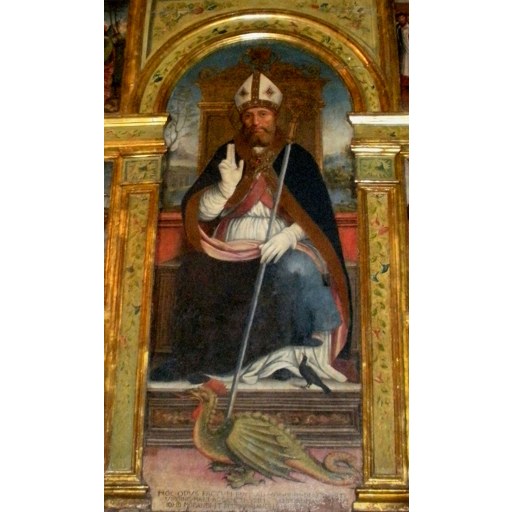
Medieval legend surrounded his figure with miracle stories. One cycle of tales describes him, while still a child, restoring a dead bird—often a crane—to life. Another, widely represented in local art and folklore, recounts that he overcame a basilisk or dragon that dwelt in a well and endangered the people of Genoa; a well near the church of San Siro was long pointed out in connection with this story. These episodes are characteristic of urban saintly legends and are not corroborated by early historical evidence, but they determined much of his later iconography, in which he may appear as a bishop accompanied by a basilisk or a crane.
Tradition assigns his death to about the year 381. He was buried in the church of the Twelve Apostles, thereafter called San Siro. That church remained closely associated with his cult and housed his relics; it served as cathedral of Genoa until the episcopal seat was moved to the church of San Lorenzo.
Veneration of Syrus as a saint is ancient and predates the later medieval and modern procedures of canonization. His feast is kept on 29 June. He is honored among the early patrons of Genoa, and the church of San Siro di Struppa stands at his traditional birthplace. Historians treat the legendary vita with caution while accepting that a bishop named Syrus was remembered as a founding figure of the Genoese church in the fourth century.