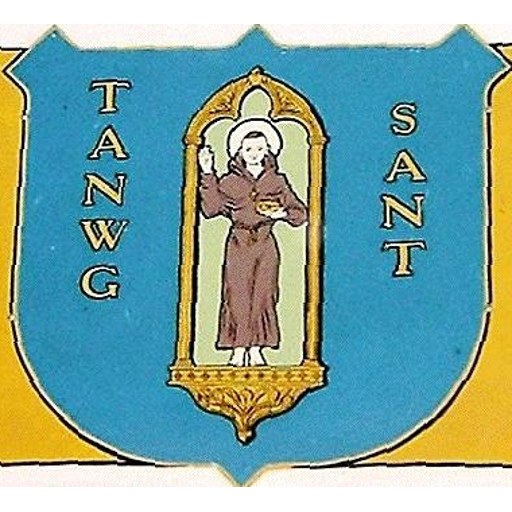
Tanwg is a saint of the Catholic Church. Tanwg is the patron saint of Llandanwg.
Thozza
License: CC BY-SA 3.0
Tanwg
Saint- Gender
- male
- Church
- Catholic
Places
Roles & Family
Patronage
Llandanwg
Biography
Saint Tanwg is a Welsh saint of the early medieval period, customarily assigned to the sixth century, whose cult is centred on Llandanwg on the coast of Ardudwy in what is now Gwynedd, north-west Wales. The place-name Llandanwg, formed from the Welsh llan, meaning an ecclesiastical enclosure or church, and the personal name Tanwg, is the chief witness to his local veneration. No contemporary biography or charter names him, and almost nothing about his life can be established from records of his own age. Like many figures of the so-called Age of the Saints in Wales, he is known through later medieval genealogies, church dedications, and the survival of a holy site rather than through a vita that could be tested against independent evidence.
According to the medieval Welsh genealogical tract Bonedd y Saint and related material, Tanwg was a son of Ithel Hael of Llydaw, that is Brittany, and one of a company of holy men who crossed from Armorica to Britain with Saint Cadfan. That group is associated in tradition with the spread of monastic Christianity in western Wales and with foundations such as Tywyn and the monastery on Bardsey Island. The same pedigrees give Tanwg a number of brothers who are themselves local saints, including Trillo, Tecwyn, Twrog, and Baglan, each tied to churches in Gwynedd and neighbouring regions. These genealogies were written down centuries after the sixth century and cannot be read as contemporary proof of family relationships or of a literal migration from Brittany. They do, however, show how medieval Welsh churches explained the origins of their patrons and linked a cluster of Ardudwy and Llŷn dedications to a single legendary kindred.
The church of Saint Tanwg at Llandanwg stands among sand dunes close to the sea, a short distance south of Harlech in historic Merionethshire. The standing fabric is largely medieval, with later repair, but the site is older. Early Christian inscribed stones of a type familiar in western Britain in the fifth and sixth centuries have been recorded there, indicating that an ecclesiastical or burial ground already existed in the period to which the saint is assigned. In later centuries drifting sand repeatedly threatened the building and the churchyard. By the nineteenth century the old church had become difficult to reach, and a new parish church, also dedicated to Saint Tanwg, was erected in Harlech to serve the congregation. The ancient church at Llandanwg was subsequently restored and remains in use, a rare survival of a coastal clas or parish church that has kept its early dedication.
No trustworthy year of birth or death, place of burial, or contemporary miracle collection has been preserved. Tanwg does not appear in the main Roman martyrologies, and there is no evidence of a papal canonisation or beatification; his sanctity rests on local Welsh tradition and on the continuity of the dedication at Llandanwg. He is not recorded as a bishop, abbot of a named house in surviving annals, or holder of any patriarchal or papal office. Modern historians therefore treat him as one of a large class of obscure local patrons whose names endured in toponymy and in church dedication while the narrative details supplied by later hagiography remain unverified. The most secure traces of the figure remembered as Saint Tanwg are archaeological and onomastic: the coastal church, the early stones, and the name Llandanwg itself.