Tarasios of Constantinople is a saint of the Catholic Church (d. 806). Tarasios of Constantinople's feast day is celebrated on 25 February.
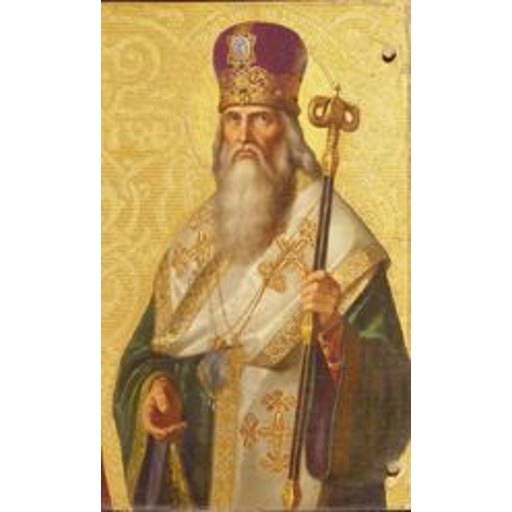
Johann Conrad Dorner (1809–1867)
License: Public domain
Tarasios of Constantinople
Saint- Life Span
- d. 806
- Feast Day
- 25 February
- Gender
- male
- Church
- Catholic
Places
Roles & Family
Biography
Tarasios of Constantinople was a leading Byzantine churchman of the later eighth and early ninth centuries and Ecumenical Patriarch of Constantinople from 784 until his death in 806. He was born in Constantinople into a family of high rank; his father served as a senior judge in the imperial administration, and the household belonged to the educated civil elite of the capital. Raised in the city, Tarasios received a thorough training in both secular letters and Christian doctrine and entered the imperial secretariat. He advanced to the office of protoasekretis, or chief secretary, at the court of Empress Irene and her son Constantine VI, becoming one of the most influential lay officials of the empire before any ecclesiastical appointment.
When Patriarch Paul IV resigned in 784, having expressed repentance for earlier compliance with imperial iconoclasm, he recommended Tarasios as his successor. Irene, who sought the restoration of the veneration of icons, supported the choice. Tarasios, still a layman, at first refused, citing both his lack of ordination and the unresolved division over images. He accepted only on the condition that an ecumenical council be summoned to settle the controversy according to the tradition of the Church. He was then tonsured as a monk and rapidly ordained through the successive degrees of the clergy, being consecrated patriarch on 25 December 784. The unusual speed of his elevation from lay status drew some contemporary criticism, but it was defended as necessary to restore canonical leadership at Constantinople.
As patriarch, Tarasios cooperated with Irene to reverse iconoclast policy. An attempt to open a council in the Church of the Holy Apostles at Constantinople in 786 was broken up by iconoclast soldiers. The assembly was reconvened the following year at Nicaea. There Tarasios, together with legates of Pope Hadrian I, presided over the Second Council of Nicaea (787), the seventh ecumenical council, which condemned iconoclasm as heresy, defined the legitimate relative veneration of holy images as distinct from the worship due to God alone, and restored communion with Rome and the other patriarchates on this question. He also sought to curb simony in clerical appointments and was remembered for personal austerity and for using patriarchal resources to aid the poor and to ransom captives.
His later patriarchate was overshadowed by the marital conduct of Constantine VI. In the mid-790s the emperor put away his wife Maria of Amnia in order to marry Theodote, a court lady. Under strong imperial pressure Tarasios eventually acquiesced in the union, a decision that provoked the Moechian controversy and a lasting breach with rigorist monastic circles, notably Theodore the Studite and the community of Sakkoudion, who regarded the second marriage as adulterous and the patriarch as too compliant toward the throne. After Irene deposed and blinded her son in 797, Tarasios remained in office during her sole rule and then under Emperor Nikephoros I, who took power in 802. He died in Constantinople on 25 February 806 and was buried in a monastery he had founded on the European shore of the Bosporus. He is venerated as a saint in both the Eastern Orthodox and Roman Catholic Churches; his principal feast is kept on 25 February. A Life was composed by Ignatios the Deacon, which remains the chief narrative source for his career.