Tatian of Aquileia is a saint of the Catholic Church. Tatian of Aquileia's feast day is celebrated on 16 March.
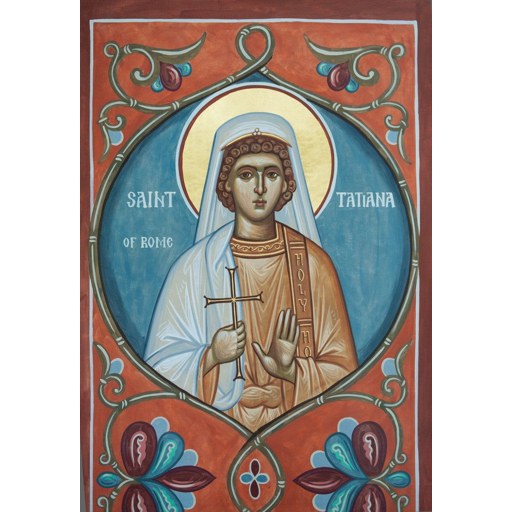
https://pinterest.com/amclark1228/st-tatiana-of-rome
License: unknown
Tatian of Aquileia
Saint- Feast Day
- 16 March
- Gender
- male
- Church
- Catholic
Places
Roles & Family
Biography
Tatian of Aquileia, also known as Tatianus, was a deacon of the church of Aquileia in northeastern Italy who is commemorated as a martyr in the Roman Martyrology. He is listed together with Hilary (Hilarius), described as bishop of Aquileia, and with companions named Felix, Largus, and Dionysius. Their feast is assigned to 16 March. Traditional hagiographical notices associate their deaths with a persecution under the Roman emperor Numerian in the late third century.
Virtually no independent historical documentation survives concerning Tatian. The martyrological entry and later passion accounts are late compositions whose details cannot be verified from contemporary sources. Historians therefore treat the specific narrative of suffering and execution with caution. Nothing is known of Tatian’s birth, family, education, or the length of his service as a deacon. Aquileia was already a significant Roman city and an early center of Christianity in northern Italy, later the seat of a prominent bishopric that became a patriarchate, yet Tatian remains a shadowy figure even within that local tradition.
The veneration of Tatian and his companions appears to have been confined largely to the Aquileian church and the surrounding territory of Friuli. No record exists of a translation of relics, of a dedicated basilica in his honor, or of particular patronages attached to his name. Recognition of his sanctity belongs to the ancient cult of martyrs rather than to any later process of beatification or canonization. Later writers associated with the church of Aquileia, such as Chromatius, do not mention him.
Because of the paucity of evidence, Tatian of Aquileia stands as an example of the many early clerics whose memory was preserved only in liturgical calendars. His story illustrates both the strength of local martyr cults in late-antique northern Italy and the severe limits of what can be recovered about individual lives from the third century.