Thaddeus of Edessa is a saint of the Catholic Church. Thaddeus of Edessa's feast day is celebrated on 5 August.
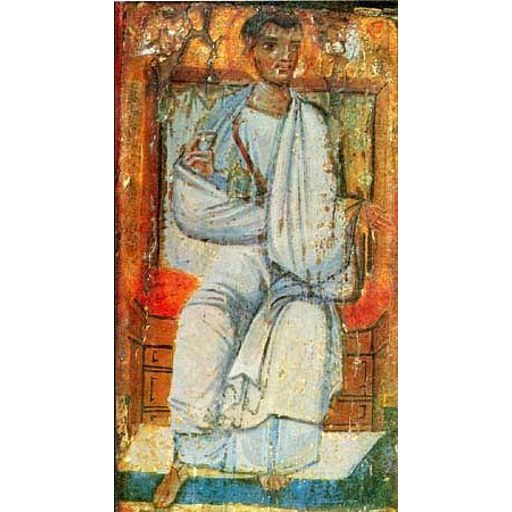
Anonymous Byzantine painter (395-1453 AD) Public domain image
License: Public domain
Thaddeus of Edessa
Saint- Feast Day
- 5 August
- Gender
- male
- Church
- Catholic
Places
Roles & Family
Biography
Thaddeus of Edessa, known in Syriac as Mar Addai (also Addaeus or Adai), is venerated in Eastern Christianity as one of the Seventy Disciples of Jesus and as the apostolic founder of the church of Edessa, capital of the kingdom of Osroene in northern Mesopotamia. Eastern tradition generally distinguishes him from Jude Thaddaeus, one of the Twelve Apostles, though later writers have sometimes conflated the two. The principal ancient accounts are a notice in the Ecclesiastical History of Eusebius of Caesarea, written in the early fourth century and said to rest on documents from the Edessene archives, and the Syriac Doctrine of Addai, a text usually dated to the late fourth or early fifth century. In these narratives he is the missionary who brought the gospel to Edessa in the apostolic age.
According to the legend, King Abgar V of Edessa, suffering from illness, wrote to Jesus asking him to come and heal him. Jesus replied that he could not come but that a disciple would be sent after his departure. After the Ascension, the Apostle Thomas dispatched Addai to the city. Addai is described as healing the king, converting Abgar and many inhabitants, preaching against pagan cults, and organizing a Christian community with clergy and a church. The Doctrine of Addai elaborates court scenes, the conversion of nobles, and the claim that a portrait of Jesus was brought to Edessa, a story later joined to the Image of Edessa. Addai is said to have taught in the city and its region and to have provided for the church’s continuance before his death.
East Syriac tradition pairs Addai with a disciple, Mar Mari, and ascribes to them the evangelization of Mesopotamia beyond Edessa, including communities that later formed the Church of the East. The ancient eucharistic anaphora known as the Liturgy of Addai and Mari is attributed to their mission and remains in use among the Assyrian Church of the East, the Ancient Church of the East, the Chaldean Catholic Church, and the Syro-Malabar Church. Addai is customarily regarded as the first bishop of Edessa. Later, largely legendary lists of catholicoi of the Church of the East sometimes set him at the head of the succession, but the historical patriarchate of Seleucia-Ctesiphon arose only in subsequent centuries; Addai is not attested as holding that later office.
No contemporary source records his year of birth, parentage, or marital status, and modern historians treat the first-century Abgar correspondence as legendary. A Christian presence in Edessa is more securely attested from the later second century, and some scholars have suggested that a historical preacher named Addai may have worked in Osroene in that period, after which the story was recast in apostolic terms. According to the Doctrine of Addai he died in Edessa and was buried there. His cult is ancient and belongs to pre-congregational veneration. Different churches keep his memory on different days, of which 5 August is among the most widely cited for Addai of Edessa; related commemorations of Thaddeus of the Seventy appear on other dates in the Byzantine calendar. He is honored as a founding apostle of Syriac Christianity rather than as the designated patron of a particular profession or illness.