Thalelæus is a venerable of the Catholic Church. Thalelæus's feast day is celebrated on 27 February.
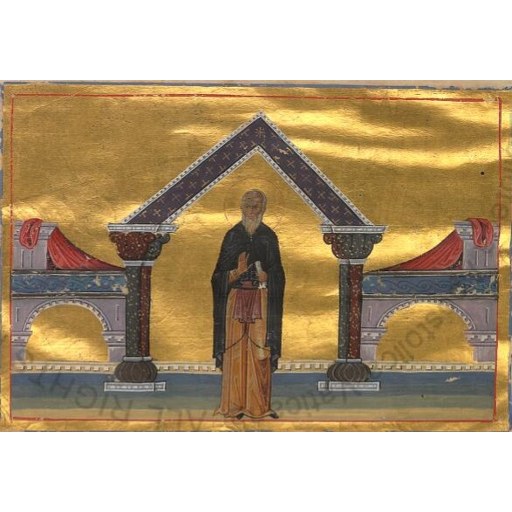
Authors of Menologion of Basil II (circa 985 AC, Constantinople), Byzantine manuscript illuminators[1]: Pantoleon with Georgios, Michael the Younger, Michael of Blachernae, Symeon, Symeon of Blachernae, Menas, and Nestor (Online on Vatican site)
License: Public domain
Thalelæus
Venerable- Feast Day
- 27 February
- Gender
- male
- Church
- Catholic
Places
Roles & Family
Biography
Thalelæus of Syria (also spelled Thalelaeus or Thalelaios) was a Christian hermit of the fifth century, known principally through the contemporary account of Theodoret of Cyrrhus in the Historia Religiosa (Religious History), a collection of lives of Syrian ascetics. Theodoret, who visited him in person, identifies him as a Cilician by origin who settled in the countryside near Gabala, a coastal city of Roman Syria (modern Jableh). No reliable source records the year of his birth or of his death. He was still living when Theodoret wrote, around the middle of the fifth century, so any later date of death is conjectural and should not be treated as established fact.
Near Gabala, Thalelæus took up residence at a site associated with a pagan shrine, a place local people regarded as haunted or dangerous. There he practiced an unusually severe form of enclosure. According to Theodoret, he constructed a cylindrical cage from two wheels joined by wooden staves; the structure was so confined that he could neither stand upright nor lie down at full length, and he remained in it, exposed to the open air, for about ten years. Later liturgical summaries sometimes add that he also occupied a small hut or cell, but the cage is the distinctive feature of the only near-contemporary description. The setting belongs to the world of fifth-century Syrian monasticism, in which spectacular bodily austerity and the Christianization of rural cult sites often went together.
Theodoret portrays Thalelæus as an educated man who could discuss Christian doctrine in polished Greek and who explained his asceticism in philosophical terms, as a discipline of the body for the sake of the soul. Despite the hardship of his enclosure he was said to have a cheerful manner. Following Theodoret, tradition credits him with converting many of the local pagan population: people came to him for healing and instruction, and the influence of the nearby shrine declined. These notices cannot be independently corroborated in detail, but they are consistent with other portraits in the Historia Religiosa of hermits who drew crowds and displaced older cults.
Thalelæus is venerated as a saint in the Eastern Orthodox Church, with a feast on 27 February. He was never the subject of a formal papal canonization of the later medieval or modern type; his cult rests on early monastic reputation and liturgical commemoration. No ancient source names a burial place, a religious order in the later Western sense, a spouse, or children. He is not recorded as having held episcopal, patriarchal, or papal office. Beyond Theodoret’s sketch and the brief entries in Orthodox synaxaria, little about his life can be verified, and he should not be confused with the physician-martyr Thalelaeus (the Unmercenary), who is a different figure with a different feast.