The 20 Hunchakian gallows is a saint of the Catholic Church (d. 1915).
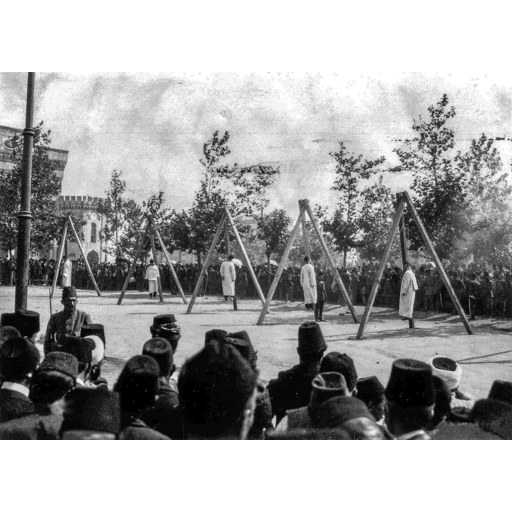
Unknown authorUnknown author
License: Public domain
The 20 Hunchakian gallows
Saint- Life Span
- d. 1915
- Gender
- male
- Church
- Catholic
Places
Roles & Family
Biography
The Twenty Hunchakian gallows designates a group of twenty members of the Social Democrat Hunchakian Party who were publicly hanged by Ottoman authorities in Constantinople on 15 June 1915. The executions were carried out in Beyazıt Square in the opening months of the Armenian Genocide, not long after the 24 April 1915 round-up of Armenian intellectuals and civic leaders in the capital. The condemned were political activists, not clergy. They belonged to a revolutionary socialist party that had long pressed for reform, and in some of its programs independence, for the Armenian provinces of the Ottoman Empire. A military court convicted them of conspiracy to assassinate leaders of the Committee of Union and Progress and of preparing an armed rising. Their deaths entered Armenian historical memory as both a political martyrdom and a chapter in the wider destruction of Ottoman Armenian society.
The Social Democrat Hunchakian Party was founded in 1887 in Geneva by Armenian students, among them Avetis Nazarbekian and Mariam Vardanian. It was the first socialist party to operate in the Ottoman and Persian empires and joined Marxist social analysis to a national program for the Armenian provinces. Through the late nineteenth and early twentieth centuries it maintained cells in Ottoman cities, the Russian Empire, and the diaspora, issued newspapers, and at times undertook armed actions. A Seventh General Convention of the party, held in Constanța, Romania, in 1913, debated how to answer the centralizing and nationalist policies of the Young Turk government; some delegates favored targeting Committee of Union and Progress leaders. Ottoman intelligence later treated those discussions as proof of a terrorist plot, a charge the defendants and later Armenian historiography have regarded as a pretext for dismantling an organized Armenian political network on the eve of mass deportations.
Arrests of Hunchakian cadres in Constantinople and other cities began in 1914 and intensified after the Ottoman Empire entered the First World War. Those seized included organizers, journalists, and physicians. They were tried by court-martial on charges of treason and conspiracy; twenty received death sentences. On 15 June 1915 they were hanged together in a public square of the Ottoman capital. The best-known among them was Paramaz (born Matteos Sarkissian), a long-time party field organizer. Other names preserved in contemporary and later accounts include Dr. Benne (Bedros Torosian), Aram Achekbashian, and Kegham Vanigian, the last associated with party publications. Accounts of the hanging describe a deliberately public spectacle meant to intimidate remaining Armenian activists in the capital. Precise biographical data for many of the twenty—dates and places of birth, family circumstances, and burial—are incompletely recorded in surviving sources, as is common for victims of the 1915 arrests.
In Armenian communal remembrance the twenty are honored as martyrs of the nation and of the Hunchakian movement. Their hanging is commemorated in party histories, monuments, and literature, and is placed within the larger chronology of the Armenian Genocide rather than treated as an isolated criminal case. They held no papal or patriarchal office and belonged to no religious order. Individual feast days, formal patronages, and a single shared birthplace or burial site are not established for the group as a whole, and marriage and children are not uniformly documented for all twenty men. In 2015 the Armenian Apostolic Church collectively canonized the martyrs of the Armenian Genocide; the hanged Hunchakians belong to that vast company of victims rather than to a separately named cult with its own distinct liturgical feast.