The Buddha is a saint of the Catholic Church. The Buddha's feast day is celebrated on Vesak.
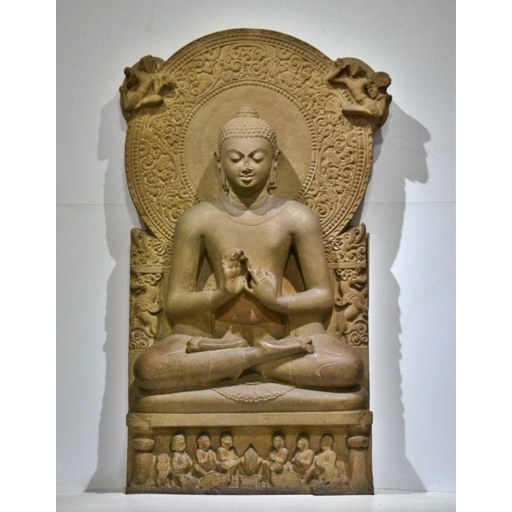
พระมหาเทวประภาส วชิรญาณเมธี (ผู้ถ่าย-ปล่อยสัญญาอนุญาตภาพให้นำไปใช้ได้เพื่อการศึกษาโดยอยู่ภา่ยใต้ cc-by-sa-3.0) ผู้สร้างสรรค์ผลงาน/ส่งข้อมูลเก็บในคลังข้อมูลเสรีวิกิมีเดียคอมมอนส์ - เทวประภาส มากคล้าย
License: CC BY-SA 3.0
The Buddha
Saint- Feast Day
- Vesak
- Gender
- male
- Church
- Catholic
Places
Roles & Family
Religious Information
Biography
The Buddha, known in his lifetime as Siddhartha Gautama (Pali: Siddhattha Gotama), was a wandering ascetic and religious teacher who lived in the eastern Gangetic plain of the Indian subcontinent during the first millennium BCE. Most historians place his activity in the fifth or fourth century BCE; traditional Buddhist chronologies have offered earlier figures, but no contemporary written record preserves a verified year of birth or death. He was born at Lumbini, in the territory of the Shakya clan, a small oligarchic republic in the Himalayan foothills corresponding to present-day southern Nepal. An inscribed pillar erected in the third century BCE by the Mauryan emperor Ashoka at Lumbini records the site as the Buddha's birthplace and remains the principal archaeological witness to that tradition. Buddhist sources name his father Śuddhodana, a leading Shakya, and his mother Māyā (Maya Devi), who is said to have died shortly after childbirth. He was raised at Kapilavastu by his maternal aunt Mahāprajāpatī Gautamī.
Early Buddhist texts and later hagiographies describe a youth spent in relative comfort, marriage to Yaśodharā, and the birth of a son named Rāhula. Around the age of twenty-nine, according to these accounts, he abandoned household life after a series of encounters—conventionally framed as the four sights of an old man, a sick man, a corpse, and a wandering renunciant—that confronted him with suffering and the possibility of a religious path. He joined the broader śramaṇa (renunciant) movements then active in the Ganges basin, studied meditative attainments under teachers including Āḷāra Kālāma and Uddaka Rāmaputta, and practised extreme austerities with five companions. Concluding that self-mortification did not lead to the knowledge he sought, he took food, adopted what Buddhist tradition calls the Middle Way between sensual indulgence and harsh asceticism, and sat in meditation at Bodh Gaya beneath a sacred fig tree. There, tradition holds, he attained awakening: a comprehensive insight into the arising and cessation of suffering.
From that point he was known as the Buddha, meaning the awakened or enlightened one. He preached his first sermon at the Deer Park in Sarnath, near Varanasi, articulating the Four Noble Truths and the Noble Eightfold Path, and thereby, in Buddhist language, set in motion the wheel of the Dhamma. He formed a monastic community, the Sangha, initially of men and later, after the intervention of Mahāprajāpatī and the monk Ānanda, of women as well. For a period traditionally given as forty-five years he travelled and taught through Magadha, Kosala, and neighbouring polities, addressing monks, nuns, and laypeople. His discourses, transmitted orally and later compiled in canons such as the Pali Tipitaka and various Sanskrit and Chinese collections, emphasise impermanence, the absence of a permanent self, dependent arising, ethical precepts, mindfulness, and the ending of craving as the path to nirvāṇa. He left no writings of his own.
Buddhist tradition reports that he died at about eighty years of age at Kuśinagara (modern Kushinagar in Uttar Pradesh, India), in the country of the Mallas, an event remembered as the parinirvāṇa. His remains were cremated; early narrative sources state that the relics were divided among several kingdoms and republics and enshrined in stupas. In subsequent centuries Buddhism spread across Asia, giving rise to Theravāda, Mahāyāna, and Vajrayāna schools, all of which regard Gautama as the Buddha of the present world-age. Commemoration of his birth, awakening, and passing is observed especially at Vesak (Buddha Day), whose date follows lunar calendars and therefore varies by country and year.