Æthelberht II is a saint of the Catholic Church (d. 794). Æthelberht II's feast day is celebrated on 20 May. Æthelberht II is the patron saint of Hereford;Hereford Cathedral.
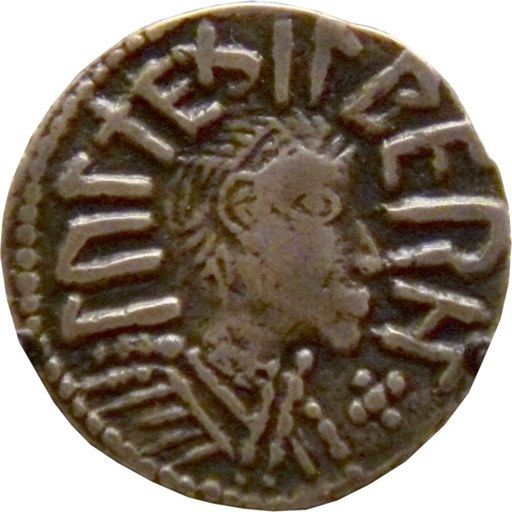
PHGCOM
License: Public domain
Æthelberht II
Saint- Life Span
- d. 794
- Feast Day
- 20 May
- Gender
- male
- Church
- Catholic
Places
Relics & Where to Venerate
Location unknown
The bodily remains of Æthelberht II are a first-class relic. Venerated at Hereford Cathedral.
Roles & Family
Patronage
Hereford;Hereford Cathedral
Biography
Æthelberht II, also known as Saint Ethelbert or Ethelbert the King, was an eighth-century ruler of the Anglo-Saxon kingdom of East Anglia, which occupied the territory of the later English counties of Norfolk and Suffolk. Almost nothing of his life can be established from strictly contemporary evidence. The principal near-contemporary notice is an entry in the Anglo-Saxon Chronicle recording that in 794 (some manuscript traditions give 792) Offa, king of the Mercians, ordered Æthelberht’s head to be struck off. Silver pennies inscribed with his name and the royal title rex show that he exercised kingship and issued coinage, but they do not reveal the length of his reign or the circumstances of his accession. Later medieval writers, drawing on hagiographical tradition rather than eighth-century records, named him as the son of King Æthelred of East Anglia and a queen called Leofruna; those genealogical details cannot be independently confirmed and should be treated with caution.
The fuller account of his death belongs to legend that developed around his cult, especially at Hereford. According to the medieval passiones, the young and pious king travelled into Mercia to seek marriage with a daughter of Offa, named Ælfthryth in some versions. At a Mercian royal residence identified as Sutton Walls, near Hereford, he was received with apparent honour and then murdered, either at the instigation of Offa’s queen Cynethryth or by Offa himself, who is said to have feared a rival or to have been persuaded that the East Anglian king threatened Mercian dominance. Æthelberht was beheaded. Hagiographers surrounded the killing with miraculous signs: a spring was said to have burst forth where his head fell, and a blind man recovered sight upon finding the body. The remains were first buried at Marden in Herefordshire and afterwards translated to the church that became Hereford Cathedral. Whatever the precise political motive—East Anglia had long been under Mercian pressure, and Offa was then at the height of his power—the killing was soon interpreted as martyrdom.
A cult of Æthelberht as a royal martyr and virgin saint took root at Hereford. By the tenth and eleventh centuries his feast was observed on 20 May, and Hereford Cathedral, jointly dedicated to the Blessed Virgin Mary and Saint Ethelbert, became the centre of his veneration. Relics associated with him were kept there until the Reformation. Churches in East Anglia and in western England were also dedicated to him, and his name appears in pre-Conquest liturgical calendars. He was never the subject of a formal papal canonization of the later medieval type; his status as a saint rests on early local cultus later accepted throughout the English church. The historical kernel remains slender: an East Anglian king who minted coins and who was put to death on Offa’s orders in the 790s. The richly detailed portrait of a chaste, miracle-working martyr-king is the product of later medieval devotion rather than of eighth-century reportage.