Theoctiste of Lesbos is a saint of the Catholic Church. Theoctiste of Lesbos's feast day is celebrated on 9 November.
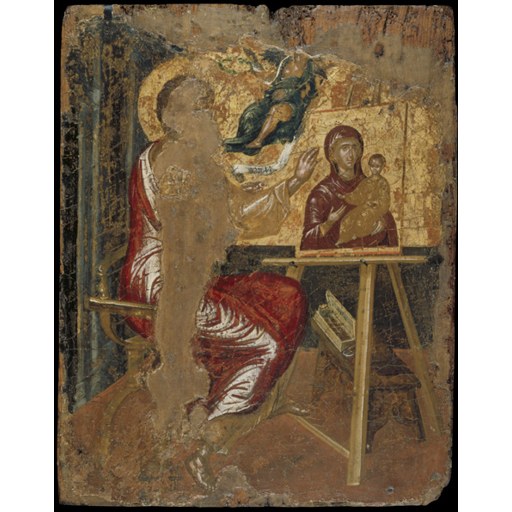
http://www.italianrenaissanceresources.com/units/unit-1/essays/saint-luke-paints-the-virgin-and-child-genealogy-of-an-image/
License: unknown
Theoctiste of Lesbos
Saint- Feast Day
- 9 November
- Gender
- female
- Church
- Catholic
Places
Roles & Family
Biography
Theoktiste of Lesbos (also spelled Theoctiste) was a ninth-century Byzantine nun and hermit venerated as a saint in the Eastern Orthodox Church. Nearly all that is known of her comes from a hagiographical Life composed in the tenth century by Niketas Magistros, a Byzantine official and man of letters. According to that account she was born in Methymna on the island of Lesbos, then part of the Byzantine Empire. Orphaned in childhood, she was taken in by a kinswoman who was a nun and was raised within a monastic community. At the age of eighteen she received the monastic tonsure and formally embraced the ascetic life.
In the ninth century the Aegean islands were repeatedly attacked by Arab raiders based on Crete, which had been seized in the 820s and remained an emirate until the Byzantine reconquest in 961. During one such raid on Lesbos the inhabitants of Methymna were carried off as captives, and Theoktiste was among them. When the raiders put in at the island of Paros in the Cyclades, she escaped into the interior. The vita states that she lived there for thirty-five years in complete solitude, surviving on wild plants, seeing no other human being, and remaining without the Eucharist.
She was eventually found by a hunter who had come to Paros. The narrative describes her as an elderly woman clothed only in her own hair and wasted by extreme fasting. She recounted her history and asked him to return the following year with the reserved sacrament so that she might receive communion before dying. He did so. After receiving Holy Communion she died, and he buried her in a church of the Theotokos on the island. When he later sought to take a relic, her remains were no longer to be found. Niketas Magistros frames the story as one he heard while delayed by weather on Paros, from a hermit acquainted with the hunter’s report.
No independent contemporary chronicle records Theoktiste’s birth or death, and no precise years can be verified from historical sources. She is placed in the ninth century because of the setting of the Cretan Arab raids and because Niketas wrote in the following century. The Eastern Orthodox Church commemorates her on 9 November. Later local tradition on Paros has sometimes identified the church of her burial with the early basilica of Panagia Ekatontapyliani in Parikia, though that identification is not explicit in the original vita. Her cult presents her as a model of female eremitic asceticism in the middle Byzantine period.