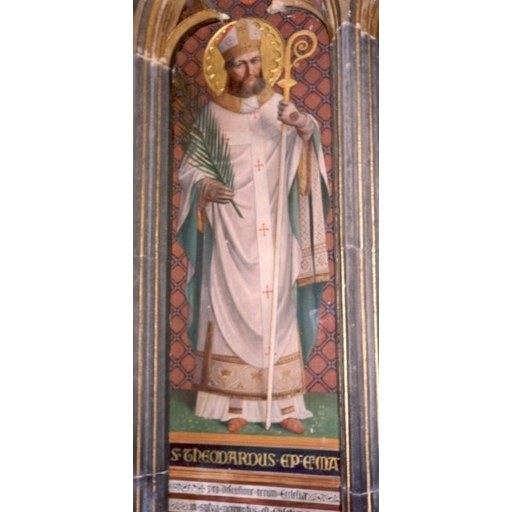
Theodard of Maastricht is a saint of the Catholic Church (d. 670). Theodard of Maastricht's feast day is celebrated on 10 September.
Diözese
License: Public domain
Theodard of Maastricht
Saint- Life Span
- d. 670
- Feast Day
- 10 September
- Gender
- male
- Church
- Catholic
Places
Relics & Where to Venerate
Location unknown
The bodily remains of Theodard of Maastricht are a first-class relic. Venerated at Liège.
Roles & Family
Religious Information
Canonization
Biography
Theodard of Maastricht, also called Theodard of Tongeren, was a seventh-century bishop of the diocese of Tongeren-Maastricht in Austrasia and is venerated as a martyr in the Latin Church. Almost nothing about his early life can be established from contemporary records. His year of birth is unknown, and later claims that he was a native of Speyer rest more on the location of his death and on a subsequent Rhineland cult than on early evidence. He is presented in hagiographical tradition as a disciple of Saint Remaclus, founder of the double monastery of Stavelot-Malmedy in the Ardennes. That house followed a monastic observance later counted as Benedictine, though in the mid-seventh century it still stood in the mixed Columbanian and Benedictine world of Frankish monasticism. After Remaclus became bishop of Maastricht, Theodard is said to have succeeded him as abbot of Stavelot-Malmedy.
When Remaclus withdrew from the episcopal office, Theodard became bishop of Maastricht, an accession traditionally placed in the early 660s. The see was the old Tongeren bishopric, then seated at Maastricht, covering a large stretch of the Meuse country in what is now eastern Belgium and the southeastern Netherlands. Later writers remember him as a pastor who sought to consolidate church life and to protect ecclesiastical estates at a time when Frankish magnates frequently encroached on monastic and episcopal land. Independent administrative documents from his pontificate do not survive, so the texture of his government is known only through this later, largely hagiographical, portrait.
Toward the end of his episcopate he undertook a journey to the court of the Austrasian king Childeric II in order to obtain royal redress for church property that nobles were said to have seized. On the way he was killed in the forest of Bienwald, in the Speyer country of what is now Rhineland-Palatinate. Tradition treats the killing as martyrdom, whether by robbers or by men connected with the dispute over the lands. The year is conventionally given as 670, though some accounts prefer 668 or 669. The forest site, near Rülzheim, became a local place of memory; English and Latin sources usually describe the death as occurring in the Bienwald near Speyer.
His successor, Saint Lambert of Maastricht, is credited with recovering the body and giving it honorable burial. As the ancient Tongeren-Maastricht church later centered itself at Liège, Theodard’s relics came to be associated with that city. Veneration also persisted in the Rhineland around the place of the murder. He was not the subject of a modern papal canonization; his cult is pre-congregation, grounded in early medieval recognition of him as a bishop-martyr. Martyrologies commemorate him on 10 September. Beyond this outline, anecdotal expansions in later vitae cannot be verified from early historical sources, and the surviving picture of Theodard remains that of an Austrasian monastic bishop whose death on a legal journey for his church made him a martyr in the memory of both the Meuse diocese and the Speyer region.