Theodora is a venerable of the Catholic Church (d. 867). Theodora's feast day is celebrated on 11 February.
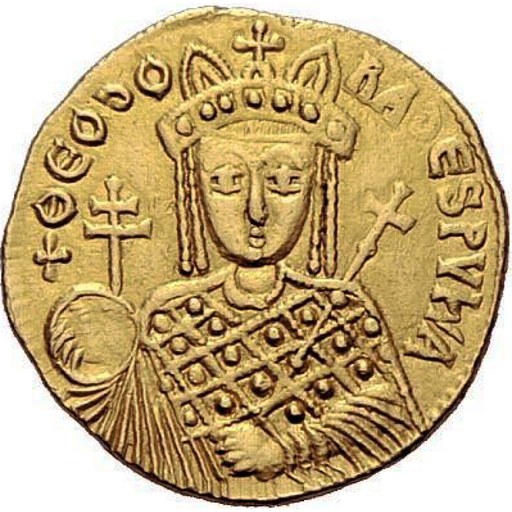
Sincona
License: Public domain
Theodora
Venerable- Life Span
- d. 867
- Feast Day
- 11 February
- Gender
- female
- Church
- Catholic
Places
Relics & Where to Venerate
Location unknown
The bodily remains of Theodora are a first-class relic. Venerated at Metropolitan church of Panagia Spilaeotissa.
Location unknown
Her remains are now housed in the Metropolitan Cathedral of Corfu, specifically in the Panagia Spilaiotissa Church
Housed at Metropolitan Cathedral · Iași, Romania
Her remains are now housed in the Metropolitan Cathedral of Corfu, specifically in the Panagia Spilaiotissa Church
Location unknown
Her remains are now housed in the Metropolitan Cathedral of Corfu, specifically in the Panagia Spilaiotissa Church
Roles & Family
Religious Information
Biography
Theodora was a ninth-century Byzantine empress, consort of Emperor Theophilos and later regent for their son Michael III. She was born in the village of Ebissa in Paphlagonia, in northern Asia Minor, to Marinos, a military officer of the rank of drungarios, and his wife Theoktiste Phlorina. The family belonged to the provincial elite of the empire; later historians sometimes ascribed Armenian ancestry to them, though that claim is not securely established. Theodora had several siblings who later became politically important, above all her brothers Bardas and Petronas. Her mother Theoktiste was noted for piety and herself entered monastic life.
In 830, after a bride-show held at the imperial palace in Constantinople, Theodora was chosen as the wife of the young emperor Theophilos, who had succeeded his father Michael II the year before. The marriage was celebrated in the Church of Saint Stephen in the Daphne palace. Although Theophilos remained a committed iconoclast, Theodora privately continued the veneration of icons. Chronicles report that she kept holy images hidden in her apartments and raised her children in the traditional Orthodox practice. The couple had seven children: Constantine, crowned co-emperor but dead in childhood; five daughters, Thekla, Anna, Anastasia, Pulcheria, and Maria; and Michael, born in 840, the future Michael III.
Theophilos died in January 842. Theodora assumed the regency for the infant Michael, governing with a council that included the logothete Theoktistos, her brother Bardas, and the magistros Manuel the Armenian. In 843 she ended the second Byzantine iconoclasm. After the removal of the iconoclast patriarch John VII Grammatikos she appointed Methodios I and convened a synod that restored the veneration of icons. That act, remembered as the Triumph of Orthodoxy, is still marked on the first Sunday of Great Lent in the Eastern Orthodox Church. During more than a decade of effective rule her government kept the finances in order and conducted campaigns against Arab forces in the east and against the Paulicians.
In 855 Michael III, encouraged by Bardas, overthrew the regency. Theoktistos was killed and Theodora was forced from the palace, tonsured as a nun, and confined with some of her daughters to the Monastery of Gastria in Constantinople. She remained there for the rest of her life. Traditional accounts place her death in 867, the same year Michael III was murdered and Basil I began the Macedonian dynasty. Because she restored the icons, the Eastern Orthodox Church venerates her as a saint; her feast is kept on 11 February.