Theodore I is a saint of the Catholic Church (d. 649).
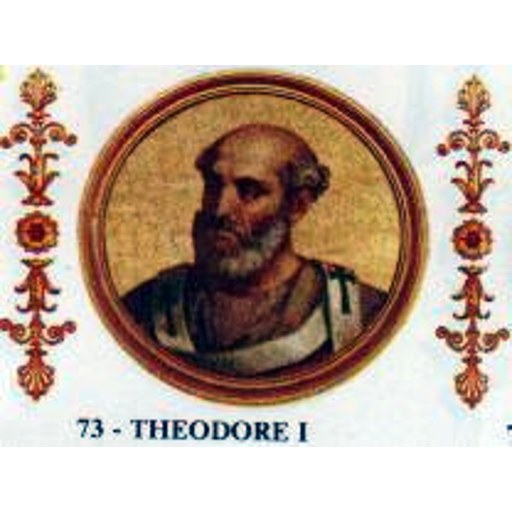
Unknown authorUnknown author
License: Public domain
Theodore I
Saint- Life Span
- d. 649
- Gender
- male
- Church
- Catholic
Places
Relics & Where to Venerate
Location unknown
The bodily remains of Theodore I are a first-class relic. Venerated at Old St. Peter's Basilica.
Roles & Family
Biography
Pope Theodore I was a Greek-speaking cleric from Jerusalem, in the Byzantine province of Palaestina Prima. The Liber Pontificalis identifies him as Greek by nation and names his father as Theodore, a bishop. No reliable source records the year of his birth, and nothing certain is known of his education or of the date at which he left Palestine for Italy. Jerusalem itself fell to the Arab conquest in 637, only a few years before his elevation, so his formation belonged to the last generation of Byzantine Christian life in the Holy City. By the early 640s he was in Rome and of sufficient standing to be chosen bishop of that see after the death of Pope John IV. He was consecrated on 24 November 642.
His pontificate was dominated by the struggle over Monothelitism, the imperial doctrine that Christ possessed only one will. Theodore rejected both the Ecthesis associated with Emperor Heraclius and the later Typos of Emperor Constans II, which sought to silence debate on the question. He refused to acknowledge Paul II of Constantinople as legitimate patriarch because of Paul’s adherence to the condemned teaching. When the former Constantinopolitan patriarch Pyrrhus came to Rome and recanted Monothelitism, Theodore received him as restored; after Pyrrhus relapsed, the pope condemned him again. Theodore also excommunicated Paul II, especially after the mistreatment of papal representatives in the imperial capital. To organize resistance in the East he appointed Stephen of Dor as papal vicar in Palestine and corresponded with bishops in Cyprus, Africa, and other regions who opposed imperial religious policy.
In Rome he combined this doctrinal conflict with ordinary pastoral work. He is credited with translating the relics of the martyrs Primus and Felician from their cemetery on the Via Nomentana to the church of Santo Stefano Rotondo on the Caelian Hill, an act typical of seventh-century Roman care for the cult of the saints. He showed concern for Eastern clergy and communities displaced or pressured by both imperial coercion and the advancing Arab conquests. Preparations for a major synod at the Lateran to give conciliar form to the Roman condemnation of Monothelitism were in hand during his last years, but he did not live to see it meet.
Theodore died in Rome on 14 May 649, after a pontificate of a little more than six years, and was buried in St. Peter’s Basilica. The Lateran Council of 649, which formally anathematized Monothelitism, was held under his successor, Pope Martin I. Theodore was not given a universal cult or a fixed feast in the later general Roman calendar, and no medieval process of canonization is recorded for him. His historical importance rests on the firmness with which the Roman see, under a pope of Eastern origin, resisted imperial theology and claimed the right to judge the faith of the Constantinopolitan patriarchate.