Theodore of Tarsus is a saint of the Catholic Church (602 - 690). Theodore of Tarsus's feast day is celebrated on 19 September.
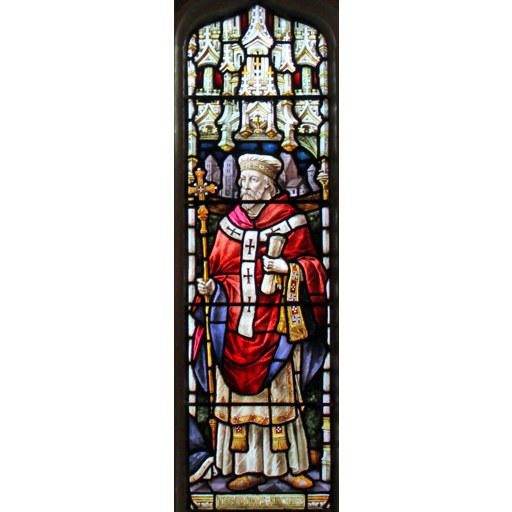
https://commons.wikimedia.org/wiki/User:Rodhullandemu
License: CC BY-SA 4.0
Theodore of Tarsus
Saint- Life Span
- 602 - 690 (age 88)
- Feast Day
- 19 September
- Gender
- male
- Church
- Catholic
Places
Relics & Where to Venerate
Location unknown
The bodily remains of Theodore of Tarsus are a first-class relic. Venerated at St Augustine's Abbey.
Roles & Family
Biography
Theodore of Tarsus, also known as Theodore of Canterbury, was a Greek monk and scholar who became the seventh Archbishop of Canterbury and a central figure in the organization of the early English Church. He was born at Tarsus in Cilicia, a city of the Byzantine Empire in Asia Minor and the traditional birthplace of the Apostle Paul, around the beginning of the seventh century. The Northumbrian historian Bede reports that Theodore was sixty-six years old when he reached Britain in 669 and eighty-eight at his death in 690, which places his birth near 602. He received a thorough education in both secular and sacred literature and was fluent in Greek and Latin. Later tradition associates him with further study at Athens and with residence in Constantinople, though the details of his early career are not fully documented. Cilicia and the eastern provinces were disturbed in his lifetime by Persian and then Arab conquests, and at some point he left the East. By the 660s he was living as a monk in Rome, where his learning and character brought him to the notice of the papal court.
In 667 Wighard, a priest of Canterbury who had been sent to Rome to be consecrated archbishop, died of plague in the city. Pope Vitalian, after considering other candidates, selected Theodore for the vacant see. The African abbot Hadrian, who had declined the office himself, was commanded to accompany Theodore to Britain, both to assist him and, according to Bede, to ensure that he introduced no Greek custom contrary to the faith. Because Theodore had received the Eastern form of tonsure, he was required to wait until his hair had grown so that he could receive the Western tonsure. He was consecrated Archbishop of Canterbury by Pope Vitalian on 26 March 668. The party travelled north through Francia and was delayed there; Theodore reached Canterbury on 27 May 669, while Hadrian arrived later after a period of detention in Gaul. Benedict Biscop also travelled with them for part of the journey. Theodore was already an old man by the standards of the age when he took up the see, yet he immediately began a vigorous visitation of the English churches.
He found many bishoprics vacant and the diocesan map of England still incomplete. He consecrated bishops, filled vacant sees, and began to subdivide the large Anglo-Saxon dioceses so that pastoral care might be more effective. In 673 he convened the Council of Hertford, the first synod of the bishops of the whole English people, which enacted canons on the dating of Easter according to the Roman reckoning, the limits of episcopal jurisdiction, the holding of regular synods, monastic stability, and other points of discipline. In 679 he held the Council of Hatfield, which affirmed the orthodox faith of the English Church in the face of the Monothelite controversy then troubling the wider Church. Together with Hadrian he established a school at Canterbury that became famous for the breadth of its teaching. Pupils there studied Scripture, Greek and Latin, metre, astronomy, ecclesiastical computation, and Roman law. Among those associated with this school were Aldhelm, later abbot of Malmesbury and bishop of Sherborne, and other future bishops and scholars. Bede wrote that some of their students knew Greek and Latin as well as their native tongue, and he regarded the period of Theodore and Hadrian as one of unusual learning in England.
Theodore's later years were marked by the difficult case of Wilfrid, bishop of York, whose extensive Northumbrian diocese Theodore divided by appointing additional bishops. Wilfrid appealed to Rome and was for a time expelled from his see; the dispute continued for years and involved the kings of Northumbria as well as papal judgments. Despite such conflicts, Bede judged that Theodore was the first archbishop whom the entire English Church consented to obey, and that during his pontificate the English churches enjoyed a greater measure of unity and instruction than before. Theodore died on 19 September 690 and was buried in the church of Saint Peter in the monastery of Saints Peter and Paul at Canterbury, later known as Saint Augustine's Abbey, near the graves of his predecessors. He was venerated as a saint from an early date. His feast is kept on 19 September in the Roman Catholic, Anglican, and Eastern Orthodox calendars. His reorganization of dioceses, his national synods, and the school at Canterbury left a lasting imprint on the English Church.