Theodore the Black is a saint of the Catholic Church (d. 1299). Theodore the Black's feast day is celebrated on 19 September. Theodore the Black is the patron saint of Yaroslavl.
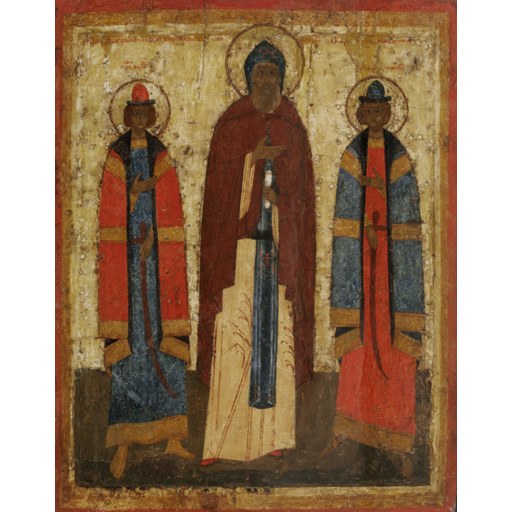
Museum of the Russian icon
License: CC BY-SA 3.0
Theodore the Black
Saint- Life Span
- d. 1299
- Feast Day
- 19 September
- Gender
- male
- Church
- Catholic
Places
Relics & Where to Venerate
Location unknown
The bodily remains of Theodore the Black are a first-class relic. Venerated at Yaroslavl.
Roles & Family
Religious Information
Patronage
Yaroslavl
Canonization
Biography
Theodore Rostislavich, known as Theodore the Black (Fyodor Rostislavich Cherny), was a thirteenth-century prince of the Smolensk branch of the Rurikid dynasty. He was the son of Rostislav Mstislavich, prince of Smolensk, and thus a descendant of the house of Vladimir Monomakh and Mstislav the Great. The year and place of his birth are not recorded in contemporary chronicles; he belongs to the generation of Rus' princes who grew up after the Mongol invasions of 1237–1240 had subjected the principalities to the Golden Horde. His epithet the Black (Cherny) is attested in later sources; its original meaning—whether a reference to dark hair or complexion, to armor or clothing, or to some other trait—is not explained in the early evidence. Before his establishment in Yaroslavl he is associated with the appanage of Mozhaisk, a Smolensk holding on the upper Moskva River.
Theodore’s principal territorial base became the principality of Yaroslavl, which he acquired by marriage to Maria Vasilievna, daughter of Prince Vasily Vsevolodovich of Yaroslavl, who left no surviving sons. This marriage, generally placed in the 1260s, made Theodore prince of Yaroslavl and tied the Smolensk princely line to a northeastern throne. He also continued to take part in the affairs of his native Smolensk house. A distinctive feature of his career, noted both in chronicles and in later Lives, was a prolonged sojourn at the court of the Golden Horde. He appears to have been in favor with the khans, and Rus' chronicles mention his participation, with other princes, in a Mongol campaign against the Alans in the North Caucasus in the late 1270s. Hagiographical tradition, written in the fifteenth and sixteenth centuries, states that after Princess Maria’s death Theodore married at the Horde a Tatar noblewoman who was baptized Anna, and that his younger sons David and Constantine were born of this second marriage. A son of the first marriage, Mikhail, died in the 1290s and did not inherit. Historians treat the more legendary coloring of the Horde marriage with caution, but the existence of the sons David and Constantine, later venerated with their father, is not in doubt.
Politically, Theodore was involved in the contested Smolensk succession. After the death of his brother Gleb Rostislavich, prince of Smolensk, in the late 1270s, Theodore pressed his own claim and at times occupied Smolensk, in rivalry with other members of the family. As with other princes of the period, patents from the Horde and military backing could decide such disputes. The details of these struggles are only partly recoverable from the chronicles, which are laconic and often composed from the standpoint of other courts. In the last years of his life Theodore is found again in Yaroslavl. Later ecclesiastical writers describe him as a devout prince who honored the clergy, founded or embellished churches, and ruled his land with justice; these traits belong to the conventional portrait of the holy prince in Rus' hagiography and cannot always be verified independently, but they shaped his subsequent cult.
Theodore died in Yaroslavl in 1299. Church tradition fixes the date as 19 September, which became his principal feast. He was buried in the cathedral of the Dormition of the Mother of God in Yaroslavl. His sons David and Constantine succeeded in Yaroslavl; David ruled as prince for many years thereafter. In 1463, in the course of rebuilding or repair work on the cathedral, the remains of Theodore and of David and Constantine were reported to have been found incorrupt. The discovery led to local canonization and to the growth of a cult of the three Yaroslavl Wonderworkers. Their veneration spread from the Rostov-Yaroslavl diocese and was received into the wider calendar of the Russian Orthodox Church. The principal feast remains 19 September, the date of Theodore’s repose; a second commemoration on 5 March marks the uncovering of the relics. Theodore the Black is thus remembered both as a historical prince of Smolensk and Yaroslavl in the Horde period and as a sainted ruler and patron of the city of Yaroslavl, together with his sons.