Théodose de Totma is a venerable of the Catholic Church (d. 1568). Théodose de Totma's feast day is celebrated on January 28.
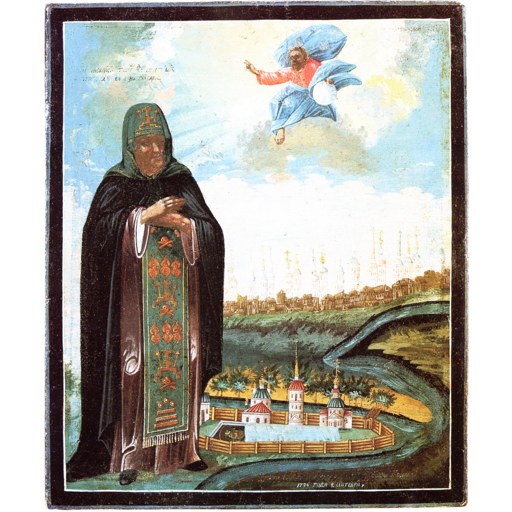
Unknown authorUnknown author
License: Public domain
Théodose de Totma
Venerable- Life Span
- d. 1568
- Feast Day
- January 28
- Gender
- male
- Church
- Catholic
Places
Roles & Family
Biography
Théodose de Totma (Russian: Feodosy Totemsky), known in secular life as Theodore Sumorin, was a sixteenth-century Russian Orthodox monk, ascetic, and founder of the Savior-Sumorin Monastery near the town of Totma in the Vologda lands of the Russian North. He was born in Vologda into a prosperous and church-minded family; no reliable source preserves an exact year of birth. According to the traditional hagiographical life, he married at his parents’ wish once he came of age, and the marriage produced a daughter. After his wife’s death he settled his affairs, made provision for his child, distributed much of his property, and entered the Savior-Priluki Monastery of Saint Demetrius, a major house on the river Vologda that stood in the lineage of northern Russian cenobitic monasticism. There he received the tonsure and the name Theodosius.
At Priluki he lived under obedience. The church tradition relates that he was later sent on monastery business to the salt-working district of Totma, a trading town on the Sukhona River whose brine wells were of economic importance to several northern monasteries. Drawn to the forests near the town, he obtained his abbot’s blessing to remain and to gather a small community dedicated to the Transfiguration of the Savior. The foundation is generally placed around 1554. Tsar Ivan IV issued a charter granting land and rights to the new house, which took the name Sumorin from Theodosius’s family. Theodosius became its first abbot. Accounts of his rule emphasize fasting, night prayer, heavy iron chains worn on the body, copying of books, and a life of poverty and manual labor among the brethren.
He died on 28 January 1568 and was buried in the monastery church. In 1626, during repair or rebuilding of the church, his coffin was opened and the body was described as incorrupt. Reports of healings at the tomb followed, and local veneration spread through the seventeenth century. The Russian Orthodox Church commemorates him as a prepodobny (venerable monastic saint). His principal feast is 28 January in the Julian calendar (10 February in the Gregorian calendar). The Spaso-Sumorin Monastery remained the center of his cult and a regional spiritual house in the Vologda lands for as long as it functioned as a monastery.
After the Russian Revolution the monastery was closed and, as with many Russian saints, the relics were taken out of liturgical use during the Soviet period. In the late twentieth century church life in Totma was revived, veneration of Theodosius was restored, and recovery of the Savior-Sumorin site began. Beyond the local cult he is remembered as one of the monastic founders of the Russian North in the age of Ivan IV: a man whose life, as the church tells it, passed from a merchant-family household and marriage to strict monastic discipline. Documentation of his early years is thin; the narrative depends chiefly on hagiographical tradition and later monastery memory rather than on a dense contemporary archive.