Theodosius of Tarnovo is a venerable of the Catholic Church (d. 1363). Theodosius of Tarnovo's feast day is celebrated on 27 November.
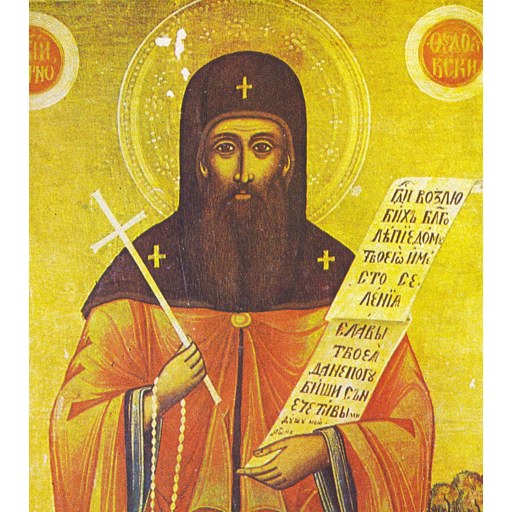
Unknown authorUnknown author
License: Public domain
Theodosius of Tarnovo
Venerable- Life Span
- d. 1363
- Feast Day
- 27 November
- Gender
- male
- Church
- Catholic
Places
Roles & Family
Biography
Theodosius of Tarnovo was a fourteenth-century Bulgarian Orthodox monk, hesychast teacher, and saint, remembered as one of the principal transmitters of Sinai and Athonite hesychasm into the Second Bulgarian Empire. Almost nothing that meets a strict historical standard is known of his birth, parentage, or childhood; later tradition associates him with the Bulgarian lands in the early decades of the fourteenth century, but no verified year or town of birth survives. He entered monastic life and, in the period when Gregory of Sinai had settled with a community at Paroria in the Strandzha mountains of southeastern Bulgaria, became Gregory’s disciple. There he was formed in the hesychast practice of inner prayer and in the Palamite theology of the uncreated light, at a time when the same movement was also unfolding on Mount Athos and in Byzantium. Other well-known disciples of Gregory in the same Bulgarian setting included figures such as Romylos of Vidin.
After Gregory of Sinai’s death in the mid-fourteenth century, raids and insecurity made Paroria hard to sustain. Theodosius left the site and spent a period moving among monastic centres, with later accounts connecting him both to other Bulgarian houses and to Mount Athos, before he returned to the political heartland of the empire. With the patronage of Tsar Ivan Alexander he established a monastery at Kilifarevo in the hills south of the capital Tarnovo, around the middle of the century. Kilifarevo became at once a hesychast hermitage and a literary school. Disciples gathered there to copy and translate theological, ascetic, and liturgical texts, and the house stood at the start of the current that modern scholarship calls the Tarnovo Literary School. Among those formed in Theodosius’s circle were Euthymius, later Patriarch of Tarnovo, and Cyprian, later Metropolitan of Kiev and All Rus’. Through them his spiritual and literary influence reached both the Bulgarian court church and the Rus’ church of the later fourteenth century.
Theodosius was also engaged in the defence of Orthodox doctrine against dualist and other heterodox movements that still had followers in the Balkans. He took part in the effort, backed by the tsar and the Tarnovo patriarchate, to identify and condemn Bogomil, Adamite, and related teachings, as well as positions associated with the anti-Palamite side of the contemporary Byzantine controversy. Church councils held in Tarnovo in the 1350s and around 1360 belong to that campaign. In 1363 he travelled to Constantinople, where he was received by Patriarch Kallistos I, himself a hesychast and former Athonite. Theodosius fell ill in the imperial city and died there on 27 November 1363. He was not a bishop, patriarch, or pope; his authority was that of a monastic teacher and hesychast elder.
Patriarch Kallistos composed a Life of Theodosius soon afterwards. That Greek vita, later known in Slavic translation, is the principal narrative source for his career and is the reason several details of his later years can be stated with some confidence while his origins remain obscure. Veneration of Theodosius as a saint took root in the Bulgarian Church and in the wider Eastern Orthodox world. He is commemorated on 27 November. Kilifarevo Monastery, though later destroyed and rebuilt, remained tied to his memory, and he is regarded as a chief link between the hesychasm of Gregory of Sinai and the Slavic Orthodox cultures of the later Middle Ages.