Thérèse of Lisieux is a saint of the Catholic Church (1873 - 1897). Thérèse of Lisieux's feast day is celebrated on 1 October. Thérèse of Lisieux is the patron saint of missions;missionaries;France;florists;aviators;people with HIV/AIDS;those who have lost parents;tuberculosis sufferers.
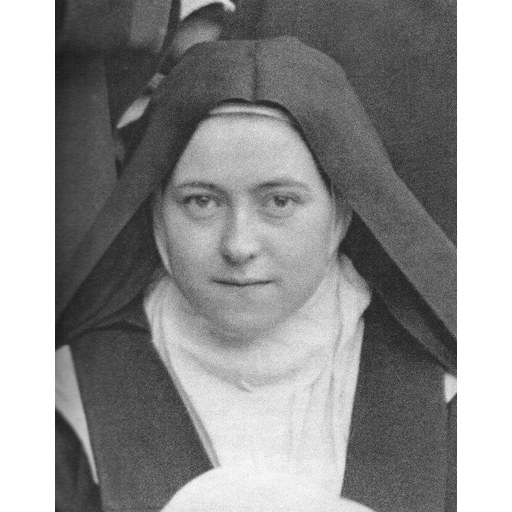
Céline Martin
License: Public domain
Thérèse of Lisieux
Saint- Life Span
- 1873 - 1897 (age 24)
- Feast Day
- 1 October
- Gender
- female
- Church
- Catholic
Places
Sacred Places


Relics & Where to Venerate
Location unknown
The bodily remains of Thérèse of Lisieux are a first-class relic. Venerated at Lisieux.
Housed at Basilica of Sainte-Thérèse, Lisieux · France
Bodily relics of St. Thérèse of Lisieux enshrined at the Basilica of Sainte-Thérèse in Lisieux.
Roles & Family
Religious Information
Patronage
missions;missionaries;France;florists;aviators;people with HIV/AIDS;those who have lost parents;tuberculosis sufferers
Canonization
Biography
Marie Françoise-Thérèse Martin was born on 2 January 1873 in Alençon, in Normandy, France, the youngest of nine children of Louis Martin, a watchmaker and jeweler, and Azélie-Marie (Zélie) Guérin, a lacemaker. Four of her siblings died in infancy or early childhood; five daughters survived to adulthood, and all five later entered religious life. Zélie Martin died of breast cancer in 1877, when Thérèse was four years old. Louis then moved the family to Lisieux to live near Zélie's brother Isidore Guérin. Raised in a devout Catholic household, Thérèse became especially attached to her sister Pauline, who took a maternal role after their mother's death. When Pauline entered the Carmelite monastery of Lisieux in 1882, the child suffered a severe crisis of health; she later attributed her recovery to what she described as a smile from a statue of the Virgin Mary. On Christmas night 1886 she experienced what she called her complete conversion, a sudden interior strengthening that, in her own account, ended a long period of childish hypersensitivity.
Determined to become a Carmelite despite her youth, she sought special permission to enter well below the usual age. In November 1887 she accompanied her father on a diocesan pilgrimage to Rome and, during an audience, asked Pope Leo XIII to allow her to enter the Carmel of Lisieux at fifteen. She entered that Discalced Carmelite monastery on 9 April 1888, received the habit in 1889, and took the religious name Sister Thérèse of the Child Jesus and of the Holy Face. She made her profession in 1890. Convent life for her was outwardly ordinary: she held the usual offices of a Carmelite nun, including work as assistant novice mistress. Inwardly she formed the spirituality she named the Little Way, a path of spiritual childhood grounded in trust in God's merciful love and in doing small, hidden daily acts with great love rather than seeking extraordinary mortifications or notable deeds.
At the request of her prioress, her sister Pauline (Mother Agnès of Jesus), she wrote autobiographical manuscripts later published as Histoire d'une âme (Story of a Soul). She also wrote poems, letters, and short pious recreations for the community. In April 1896 she suffered a pulmonary haemorrhage, the first clear sign of tuberculosis. During roughly the last eighteen months of her life she endured intense physical pain and a prolonged trial of faith, which she described as walking in a dark tunnel without the consolation of earlier certainties. She died at the Carmel of Lisieux on 30 September 1897, aged twenty-four. After her death her writings were circulated first among other Carmels and then more widely; popular devotion to her grew with unusual speed in the early twentieth century.
She was beatified by Pope Pius XI on 29 April 1923 and canonized by the same pope on 17 May 1925. In 1927 Pius XI named her, together with Francis Xavier, a principal patron of the missions. Pope Pius XII declared her secondary patroness of France in 1944. Pope John Paul II proclaimed her a Doctor of the Church on 19 October 1997, one of the few women to receive that title. Her parents, Louis and Zélie Martin, were themselves canonized in 2015. After an initial burial in the municipal cemetery of Lisieux, her remains were transferred to the chapel of the Carmel of Lisieux, where her relics are venerated; the nearby Basilica of Sainte-Thérèse is a major pilgrimage church. Her feast is kept on 1 October in the General Roman Calendar.