Thomas Becket is a saint of the Catholic Church (d. 1170). Thomas Becket's feast day is celebrated on 29 December. Thomas Becket is the patron saint of secular clergy;Canterbury;Portsmouth;Exeter College, Oxford.
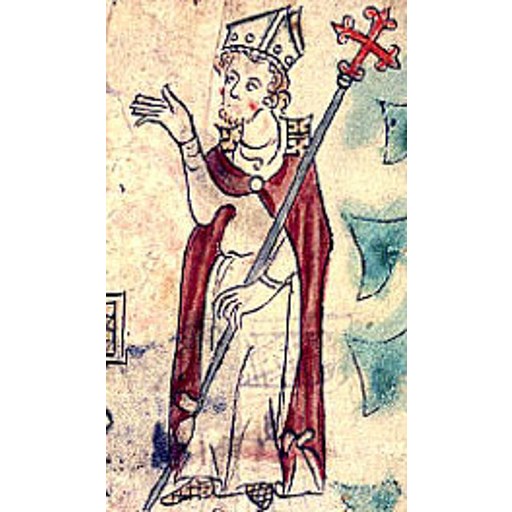
Peter of Langtoft
License: Public domain
Thomas Becket
Saint- Life Span
- d. 1170
- Feast Day
- 29 December
- Gender
- male
- Church
- Catholic
Places


Relics & Where to Venerate
Location unknown
The bodily remains of Thomas Becket are a first-class relic. Venerated at Canterbury Cathedral.
Roles & Family
Patronage
secular clergy;Canterbury;Portsmouth;Exeter College, Oxford
Canonization
Biography
Thomas Becket was born in London in the early twelfth century, conventionally placed around 1118 to 1120, the son of Gilbert Beket, a merchant of Norman stock who had settled in Cheapside and at times served as a sheriff of the city, and of Matilda (also called Rohese). The family was prosperous but not of the high nobility. Becket was educated first in London, including time at the Augustinian house of Merton in Surrey, and then in Paris, the leading centre of northern French learning. After returning to England he worked as a clerk, spent a short period in the household of a kinsman, Osbert Huitdeniers, and about the mid-1140s entered the familia of Theobald of Bec, Archbishop of Canterbury. Theobald employed him on diplomatic missions to the papal curia and enabled him to study civil and canon law, probably at Bologna and Auxerre. In 1154 Becket was made Archdeacon of Canterbury, a lucrative and influential office, and in 1155 King Henry II appointed him chancellor of England. As chancellor he became the king’s intimate friend and principal administrator, raising and leading troops, conducting embassies, and living with a magnificence that impressed contemporaries.
Henry II, wishing to retain control over the English Church after the death of Theobald in 1161, pressed for Becket’s election as Archbishop of Canterbury, which took place in 1162. Becket, still a deacon, was ordained priest on 2 June and consecrated the following day. He then surrendered the great seal, distanced himself from the royal court, and adopted a stricter personal regimen, including a hair shirt. The king’s expectation that his former servant would subordinate the Church to the Crown was disappointed. Dispute arose over the trial and punishment of clerks accused of secular crimes, over vacant sees and church lands, and over the right of appeal to Rome. At Clarendon in 1164 Henry caused a written statement of alleged ancestral customs to be drawn up; Becket and the bishops were pressured into oral acceptance, but Becket later refused formal confirmation. Cited to a council at Northampton, he was charged with financial irregularities from his chancellorship and with contempt. In late 1164 he escaped in disguise to Flanders and made his way to the court of Louis VII of France and to Pope Alexander III, then residing in France because of the papal schism. For most of his exile he stayed at Pontigny Abbey and afterwards at the Benedictine monastery of Sainte-Colombe at Sens, issuing censures against royal servants and corresponding widely in defence of ecclesiastical liberty.
A settlement brokered in 1170 permitted Becket to return to his see. He landed in England in early December and was received with popular enthusiasm but with hostility from royal officials and from the bishops who had crowned Henry’s eldest surviving son, Henry the Young King, at York in June 1170 in defiance of Canterbury’s rights. Becket excommunicated or suspended the offending prelates. News of these sentences reached Henry II in Normandy and provoked an outburst in which he is reported to have asked whether no one would rid him of the turbulent priest. Four knights—Reginald FitzUrse, Hugh de Morville, William de Tracy, and Richard le Breton—crossed to England, confronted Becket in his palace, and on the late afternoon of 29 December 1170 followed him into Canterbury Cathedral. There, in the north transept, they murdered him with sword blows, the last of which scattered his brains on the pavement, as recorded by the clerk Edward Grim, who was himself wounded trying to protect the archbishop. The atrocity caused an immediate sensation. Pilgrims flocked to the crypt; miracles were recorded in large numbers; and on 21 February 1173 Pope Alexander III formally canonized Thomas. In July 1174 Henry II walked barefoot into Canterbury and submitted to scourging by the monks as public penance. In 1220 Archbishop Stephen Langton translated the relics to a gold-plated shrine in the Trinity Chapel, which thereafter ranked among the most visited sanctuaries in Europe.
During the English Reformation the shrine was demolished in 1538 on the orders of Henry VIII, who regarded Becket as a traitor rather than a saint; the cult was prohibited and the treasures confiscated. Whether the bones were burned, reburied, or otherwise dispersed remains a matter of scholarly discussion. Becket’s principal feast is 29 December, the day of his martyrdom; a feast of the translation on 7 July was widely observed in the later Middle Ages. He is invoked as a patron of secular clergy and is associated with Canterbury, with the English town of Portsmouth, and with Exeter College, Oxford. Medieval and modern writers have portrayed him variously as a champion of the Church against the state, as a proud and intransigent prelate, and as a convert from worldly ambition to spiritual seriousness. The principal contemporary sources include the lives and letters assembled in the Quadrilogus tradition, the correspondence of John of Salisbury, and the eyewitness testimony of Edward Grim and others present in the cathedral.