Thomas de Cantilupe is a saint of the Catholic Church (1218 - 1282). Thomas de Cantilupe's feast day is celebrated on 2 October. Thomas de Cantilupe is the patron saint of Hereford;Diocese of Hereford.
Mattana
License: Public domain
Thomas de Cantilupe
Saint- Life Span
- 1218 - 1282 (age 64)
- Feast Day
- 2 October
- Gender
- male
- Church
- Catholic
Places
Roles & Family
Patronage
Hereford;Diocese of Hereford
Canonization
Biography
Thomas de Cantilupe, also known as Thomas of Hereford, was born about 1218 at Hambleden in Buckinghamshire, in the Kingdom of England. He was a younger son of William de Cantilupe, a magnate who served King Henry III as steward of the royal household, and of Millicent de Gournay. The Cantilupes were of Norman descent and had risen through royal service in the twelfth and thirteenth centuries. An uncle, Walter de Cantilupe, Bishop of Worcester from 1236 until 1266, was a leading English prelate and a counsellor associated with the baronial opposition; family standing and that episcopal example shaped Thomas’s path into the Church. Destined for clerical life, he received a thorough education in the schools of the thirteenth century.
He studied at the University of Oxford and continued in France at Paris and at Orléans, then a noted centre for civil law. He became a doctor of canon law, lectured, and in the early 1260s served as Chancellor of the University of Oxford, a post that involved him in the government of the schools and in recurrent disputes between scholars and the town. Like many well-connected clerks of his class he held a plurality of benefices, among them the archdeaconry of Stafford in the diocese of Coventry and Lichfield and various prebends, which supported him while he remained active in academic and public life. He was a secular clerk rather than a member of a religious order, and he lived as a celibate churchman.
The Second Barons’ War drew him into national politics. He supported Simon de Montfort and the reform programme associated with the Provisions of Oxford. After the baronial victory at Lewes in 1264, Montfort’s government appointed Cantilupe Lord Chancellor of England in 1265. He held the great seal only briefly. The royalist triumph at Evesham in August 1265 ended the baronial regime; Montfort was killed and many adherents were disinherited. Cantilupe withdrew, spent time in France, and later made his peace with the Crown. Under Henry III and Edward I he resumed ecclesiastical preferment without returning to high secular office.
In 1275 the cathedral chapter of Hereford elected him bishop, and he was consecrated later that year. His episcopate of some seven years left a strong impression of personal austerity, charity to the poor, and legal tenacity in defence of his see. He worked to restore clerical discipline in a border diocese that included Welsh Marcher lordships, and he litigated to recover rights and temporalities. He clashed with Gilbert de Clare, Earl of Gloucester, over hunting and forest rights in the Malvern Hills. A graver conflict with Archbishop John Peckham of Canterbury concerned metropolitan visitation, the obedience of Hereford clergy, and Peckham’s claims of jurisdiction. Peckham excommunicated Cantilupe. The bishop appealed to the papal curia and set out for Italy, where Pope Martin IV was then residing at Orvieto.
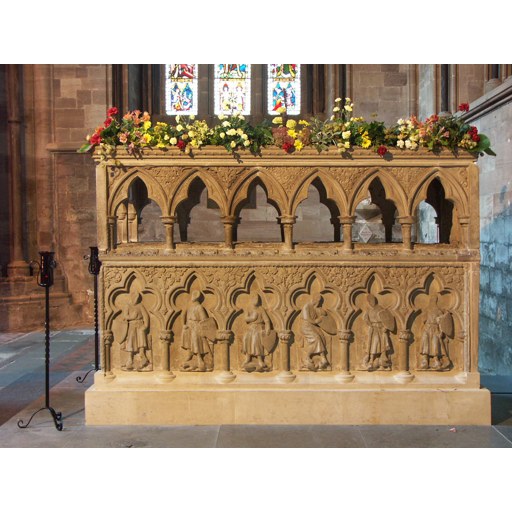
Cantilupe died on 25 August 1282 at Ferento, near Montefiascone in the Papal States, before his case was fully resolved. In accordance with contemporary practice for a prelate who died abroad, his remains were divided: the bones were brought back to Hereford Cathedral, the heart was later placed at the college of Bonhommes at Ashridge in Buckinghamshire, and other remains were left in Italy. Miracles of healing were soon reported at his tomb. His successor, Richard Swinfield, fostered the cult and gathered testimony. A formal canonical inquiry into his life, virtues, and alleged miracles was conducted in the early fourteenth century. Pope John XXII canonized him on 17 April 1320. Saint Thomas of Hereford was thereafter honoured on 2 October. His shrine in Hereford Cathedral became an important pilgrimage centre until it was dismantled at the Reformation. He was the last Englishman canonized before the Reformation and remains the principal medieval saint of the diocese of Hereford, remembered as a scholar-bishop, a brief chancellor of England, and a defender of ecclesiastical rights who died while seeking justice at the apostolic see.