Thomas the Apostle is a saint of the Catholic Church (d. 72). Thomas the Apostle's feast day is celebrated on 3 July (Roman Catholic and many Eastern churches); 6 October (Eastern Orthodox); 21 December (traditional Latin). Thomas the Apostle is the patron saint of India;Pakistan;Sri Lanka;architects;builders;construction workers;geometricians;masons;stone cutters;surveyors;theologians;against doubt;blind people.
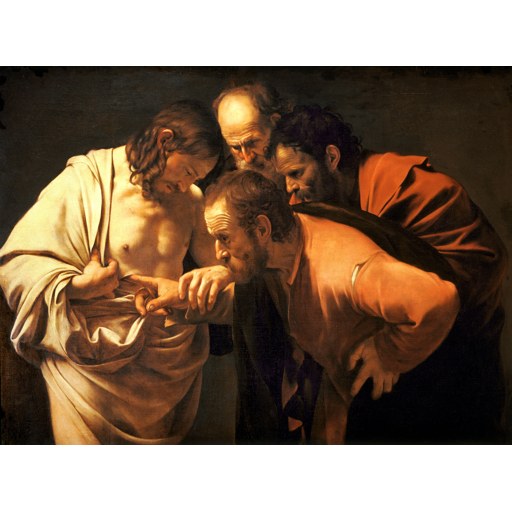
Caravaggio
License: Public domain
Thomas the Apostle
Saint- Life Span
- d. 72
- Feast Day
- 3 July (Roman Catholic and many Eastern churches); 6 October (Eastern Orthodox); 21 December (traditional Latin)
- Gender
- male
- Church
- Catholic
Places
Sacred Places


Relics & Where to Venerate
Location unknown
The bodily remains of Thomas the Apostle are a first-class relic. Venerated at San Thome Basilica.
Location unknown
==== Iraq ==== The purported finger bones of Saint Thomas were discovered during restoration work at the Church of Saint Thomas in Mosul, Iraq in 1964, and were housed there until the Fall of Mosul, after which the relics were transferred to the Monastery of Saint Matthew on 17 June 2014
Housed at Cathedral Church of Saint Matthew · United States
==== Iraq ==== The purported finger bones of Saint Thomas were discovered during restoration work at the Church of Saint Thomas in Mosul, Iraq in 1964, and were housed there until the Fall of Mosul, after which the relics were transferred to the Monastery of Saint Matthew on 17 June 2014
Location unknown
The bodily remains of Thomas the Apostle rest at San Thome Basilica, Chennai, India. (Apostolic tomb, under the care of the Catholic Church.)
Roles & Family
Patronage
India;Pakistan;Sri Lanka;architects;builders;construction workers;geometricians;masons;stone cutters;surveyors;theologians;against doubt;blind people
Biography
Thomas the Apostle, also known as Didymus (Greek for "twin"; the Aramaic name Toma has the same meaning), was one of the Twelve Apostles of Jesus. He is named in the lists of the Twelve in the Synoptic Gospels and in Acts. The Gospel of John gives him a distinctive voice. When Jesus resolved to go to Bethany despite the danger after Lazarus's death, Thomas said to his fellow disciples, "Let us also go, that we may die with him." At the Last Supper he asked, "Lord, we do not know where you are going. How can we know the way?" and received the answer, "I am the way, and the truth, and the life." After the Resurrection, Thomas, who had been absent when Jesus first appeared to the others, refused to believe unless he saw the mark of the nails and put his hand into Jesus's side. Eight days later Jesus appeared again and invited him to do so; Thomas answered, "My Lord and my God." Jesus replied that those who have not seen and yet believe are blessed. This episode, more than any other, shaped his later reputation in Christian memory.
The canonical New Testament is silent about Thomas's life after the early chapters of Acts. Fourth-century writers, drawing on earlier tradition, assigned him a missionary field in the East. Origen, quoted by Eusebius of Caesarea, stated that Thomas was allotted Parthia. A substantial body of Syriac and later Indian tradition, already reflected in the third-century Acts of Thomas, holds that he evangelized India. In that narrative Thomas is taken to the court of the Indo-Parthian king Gondophares (a ruler independently attested by coins and inscriptions in the first century) as a carpenter, preaches, converts members of the royal household, and later works on the Malabar Coast and at Mylapore. The Saint Thomas Christians of Kerala have from early times claimed that the apostle landed at Muziris (near modern Kodungallur), founded seven churches, and died a martyr on the Coromandel Coast. Independent confirmation of a Christian presence in India by the sixth century (Cosmas Indicopleustes) and of ancient ties to the Church of the East is secure; whether the apostle himself reached South India cannot be demonstrated from contemporary documents and remains a subject of historical discussion, though the tradition is among the oldest continuous claims of apostolic foundation outside the Roman Empire.
According to the same tradition, Thomas was killed by spearing at Mylapore about the year 72 and was buried there. A tomb associated with him has been venerated at Mylapore from an early date; the Portuguese erected a church over the site in the sixteenth century, succeeded by the present San Thome Basilica in Chennai. Relics identified as his were also honored at Edessa in Mesopotamia by the fourth century, as attested by Ephrem the Syrian; they were later moved to Chios and, in 1258, to Ortona in Italy, where they are kept in the Cathedral of Saint Thomas the Apostle. His principal feast in the Roman Catholic Church and in several Eastern churches is 3 July, the date associated with the translation of relics to Edessa; the Byzantine calendar keeps 6 October, and the older Latin date of 21 December survives in some uses. He is invoked as patron of India and of architects, builders, masons, and those who struggle with doubt. He was not Bishop of Rome, nor did he hold the later office of patriarch, though churches of the East regard him as their apostolic founder. No reliable early source records that he married or had children.
The confession "My Lord and my God" has been important in Christian theology as an explicit affirmation of the divinity of the risen Christ. In art Thomas is often shown placing his finger in Christ's side (the Incredulity of Saint Thomas), a scene treated by Caravaggio and many others, or holding a carpenter's square or a spear, the instrument of his martyrdom. Apocryphal literature associated with his name includes not only the Acts of Thomas but also the Gospel of Thomas, a collection of sayings preserved in Coptic from Nag Hammadi, and the Infancy Gospel of Thomas; these works are not regarded as historically reliable accounts of the apostle and in some cases reflect later Gnostic or popular piety. His cult is ancient in both East and West, and the churches of Kerala continue to celebrate him as their father in the faith.