Titus Brandsma is a saint of the Catholic Church (1881 - 1942). Titus Brandsma's feast day is celebrated on 27 July. Titus Brandsma is the patron saint of Catholic journalists;journalists;Friesland.
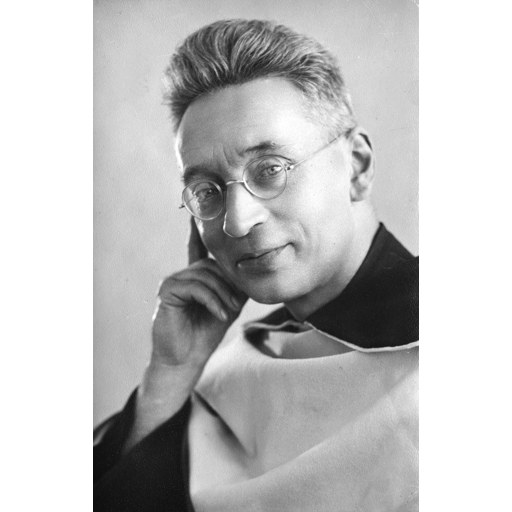
Unknown photographer
License: Public domain
Titus Brandsma
Saint- Life Span
- 1881 - 1942 (age 61)
- Feast Day
- 27 July
- Gender
- male
- Church
- Catholic
Places
Roles & Family
Religious Information
Patronage
Catholic journalists;journalists;Friesland
Canonization
Biography
Titus Brandsma was born Anno Sjoerd Brandsma on 23 February 1881 in Oegeklooster, a hamlet near Bolsward in Friesland, in the Netherlands, to a devout Catholic family of dairy farmers. His parents were Titus Brandsma and Tjitsje Postma. In a region where Catholics formed a minority, the household practiced the faith with conviction. Drawn to religious life, he entered the Carmelite novitiate at Boxmeer in 1898 and received the name Titus in honor of his father. After profession he was ordained a priest in 1905 and was sent to Rome, where he earned a doctorate in philosophy from the Pontifical Gregorian University in 1909.
Returning to the Netherlands, he taught philosophy and the history of mysticism in Carmelite houses of study and became a recognized scholar of the medieval Dutch and Rhineland mystical tradition. In 1923 he joined the faculty of the newly founded Catholic University of Nijmegen as professor of philosophy and of the history of piety, and he served as rector magnificus in 1932–1933. Alongside academic work he was a journalist and ecclesiastical adviser to the Catholic press, seeking to strengthen independent Catholic newspapers and a Catholic intellectual culture. He learned Esperanto and took part in the international Catholic Esperanto movement, and he lectured widely on Carmelite spirituality and on the responsibilities of the press.
From the 1930s he publicly criticized National Socialism as a pagan ideology incompatible with Christianity. After the German occupation of the Netherlands in 1940 he assisted the Dutch bishops in resisting the nazification of Catholic institutions. In January 1942 he was commissioned to visit editors of Catholic newspapers and to convey the bishops’ instruction that they must not print National Socialist propaganda or accept related advertising. While carrying out that mission he was arrested by the Gestapo on 19 January 1942. He was held at Scheveningen, then at Amersfoort and Kleve, and in June 1942 he was deported to the Dachau concentration camp.
At Dachau he was subjected to forced labor, malnutrition, and the camp’s brutal regime. Weakened by illness, he was killed on 26 July 1942 by a lethal injection of phenol in the camp infirmary. Fellow prisoners later testified to his patience, prayer, and charity. His body was cremated at the camp. He was beatified as a martyr by Pope John Paul II on 3 November 1985. A healing attributed to his intercession was accepted for canonization, which Pope Francis celebrated on 15 May 2022 in Saint Peter’s Square. The Church commemorates him on 27 July. He is honored as a patron of Catholic journalists and of Friesland, and as a witness to freedom of conscience and of the press under totalitarian persecution.