Tremorus of Brittany is a saint of the Catholic Church. Tremorus of Brittany's feast day is celebrated on 7 November. Tremorus of Brittany is the patron saint of Carhaix-Plouguer.
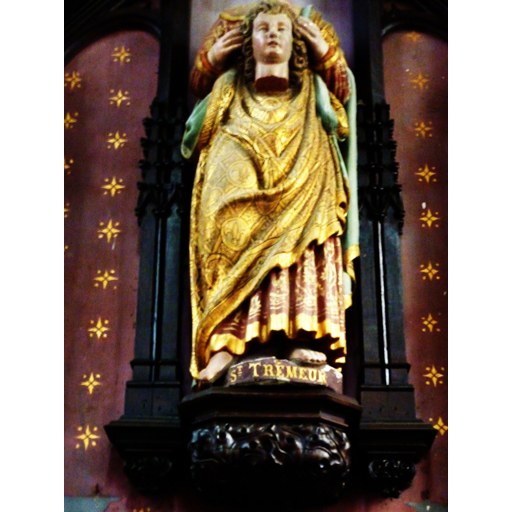
Moreau.henri
License: CC BY-SA 3.0
Tremorus of Brittany
Saint- Feast Day
- 7 November
- Gender
- male
- Church
- Catholic
Places
Roles & Family
Patronage
Carhaix-Plouguer
Biography
Saint Tremorus, known in French as Saint Trémeur and in Breton as Sant Tremeur, is a saint of early medieval Brittany whose memory is preserved in later hagiographical legend rather than in contemporary sixth-century documentation. Tradition places him in the sixth century and identifies him as the son of Saint Triphine (also Tryphina or Tréphine) and of Conomor (Comorre or Cunomorus), a ruler associated with the territory of Poher in western Brittany, a district whose chief place was Carhaix. Conomor is a figure in whom possible historical recollection and folklore are hard to separate. Breton tradition cast him as a cruel prince who murdered his wives when they became pregnant, after a prophecy that he would die at the hands of his own son. That characterization was later drawn into comparison with the Bluebeard folktale. Tremorus himself is presented throughout the legend as a child or youth, not as a bishop, monk of a named order, or public office-holder.
According to the received story, Triphine, described as a daughter of Waroch, a king of the Broerec around Vannes, was given in marriage to Conomor. When she conceived she fled; some versions say Saint Gildas assisted her. Conomor overtook her and beheaded her. Gildas is then said to have restored her to life. She gave birth to Tremorus and afterwards withdrew from secular life, while the child was raised apart from his father, in some accounts in a monastic setting linked with Gildas. When Conomor learned of the boy’s existence he seized and killed him, typically by beheading. Later Breton art sometimes shows Tremorus as a child cephalophore, carrying his own head, a motif common among regional martyr saints. The tale cannot be confirmed from sixth-century sources and is generally treated by historians as a medieval legendary construction, possibly combining a faint memory of a violent local dynast with miracle stories attached to Gildas and with the theme of the innocent child-martyr.
Despite the legendary character of the vita, a genuine local cult developed in Brittany. Tremorus became the patron of Carhaix (Carhaix-Plouguer) in Finistère, where the principal parish church, the Église Saint-Trémeur, is dedicated to him. Place-names and lesser dedications, including the commune of Trémeur, attest to the spread of his name. His mother Triphine likewise received a local cult, notably associated with Sainte-Tréphine in Côtes-d’Armor. The feast of Tremorus has customarily been kept on 7 November in Breton and French calendars of saints. He does not occupy a prominent place in the universal Roman Martyrology, and any formal recognition of his cult belongs to the older pattern of popular acclamation and local episcopal acceptance rather than to a later papal process of canonization or beatification.
Beyond this legendary cycle and the evidence of dedication and patronage, almost nothing can be established about Tremorus as a historical individual. The sources present him as a child or youth who did not marry and who left no descendants. He held no patriarchal or papal office. His importance is regional: he illustrates how early medieval Armorica produced a distinctive hagiography in which family tragedy, monastic miracle-workers, and child martyrdom were woven into the religious memory of particular towns, above all Carhaix, where his name and patronage have endured.