Trésain is a saint of the Catholic Church (d. 550). Trésain's feast day is celebrated on 7 February. Trésain is the patron saint of Avenay-Val-d'Or.
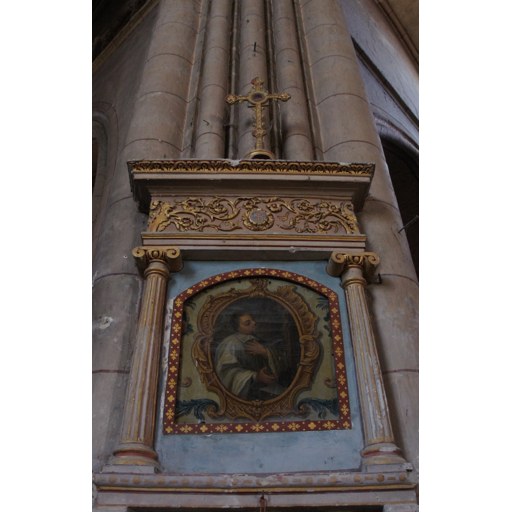
G.Garitan
License: CC BY-SA 3.0
Trésain
Saint- Life Span
- d. 550
- Feast Day
- 7 February
- Gender
- male
- Church
- Catholic
Places
Roles & Family
Patronage
Avenay-Val-d'Or
Biography
Saint Trésain (Latin Tresanus; also Tresain or Tresan) was a sixth-century Irish priest and confessor whose memory was preserved in the local cult of Champagne. Traditional accounts, which rest on medieval liturgical commemoration rather than on a contemporary narrative vita of high independent value, present him as a native of Ireland. Like many Irish ecclesiastics of the early Middle Ages he left his homeland as a peregrinus pro Christo. He is said to have travelled to Gaul with six companions, sometimes described as brothers or fellow missionaries, and to have settled in the Frankish ecclesiastical orbit of Reims in what is now northeastern France.
There he was received by Saint Remigius (Rémi), bishop of Reims, the prelate who had baptized Clovis and who organized the church in the Merovingian kingdom. Remigius ordained Trésain to the priesthood and assigned him to pastoral charge of the church at Mareuil-sur-Ay on the river Marne, in the diocese of Reims. The neighbouring locality of Avenay (today Avenay-Val-d'Or in the department of the Marne) is equally and more lastingly associated with his name. In this rural Champagne setting he served as priest and confessor among a recently or still only partly Christianized population. The sources stress personal holiness and priestly ministry rather than episcopal rank, a named monastic order, or a foundation of his own.
Trésain died in the mid-sixth century. The date customarily given in early modern hagiography, about the year 550, is consistent with a career that began under Remigius, who died in 533. He was commemorated as a confessor, not as a martyr. His relics came to be kept at Avenay. In the seventh century, around 660, a Benedictine nunnery was established there by Saint Bertha (Berthe) of Avenay, and that church became the principal focus of his cult. The Roman Martyrology records him on 7 February at Avenay in Champagne (Avenaci, in Campania Gallicana), identifying him as a priest. According to later reports, the relics preserved at the nunnery were destroyed or scattered when Calvinist forces sacked the house in the sixteenth century.
Independent sixth-century documentation of his life is lacking, and historians treat the outline with the caution usual for obscure Irish missionaries whose memory survived mainly in local cult, in martyrological entries (including Usuard and the Roman Martyrology), and in compilations such as Alban Butler’s. He held neither the papacy nor a patriarchal see, nor is he recorded as a bishop. Veneration remained essentially regional, centred on the Reims–Champagne area and on Avenay-Val-d'Or, of which he is regarded as a patronal saint. He was not the subject of a formal papal canonization of the later medieval or modern type; his status rests on ancient liturgical and popular cultus. His feast continues to be noted on 7 February in traditional calendars.