Trophimus is a saint of the Catholic Church. Trophimus's feast day is celebrated on 29 December. Trophimus is the patron saint of Arles.
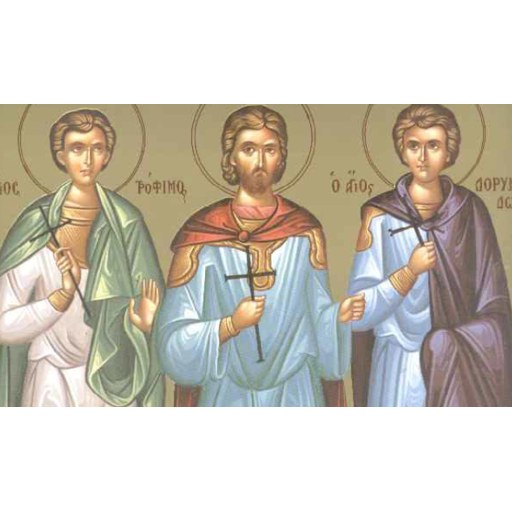
https://handmadeiconsgreece.myshopify.com/products/saints-trophimus-sabbatius-and-dorymedon-of-synnada
License: unknown
Trophimus
Saint- Feast Day
- 29 December
- Gender
- male
- Church
- Catholic
Places
Roles & Family
Patronage
Arles
Biography
Saint Trophimus is venerated as the first bishop of Arles in Roman Gaul. Almost nothing about his life can be fixed from contemporary documents, and later tradition recast him as an apostolic founder. The earliest relatively sober notice is that of Gregory of Tours in the late sixth century, who names Trophimus among seven bishops said to have been sent from Rome to Gaul in the consulship of Decius and Gratus, that is about the year 250, in the period of the Decian persecution. In Gregory’s list Trophimus was assigned to Arles, Gatianus to Tours, Paul to Narbonne, Saturninus to Toulouse, Dionysius to Paris, Stremonius to Clermont, and Martial to Limoges. Historians generally read this as a memory of a mid-third-century organized mission rather than as a precise chronicle, but it remains the principal ancient testimony that a bishop named Trophimus stood at the origins of the church of Arles. No reliable source records his parentage, birthplace, or the year of his death; those fields cannot be filled from evidence.
From the fifth century onward the church of Arles, competing for primacy among the Gallic sees, promoted a far more exalted origin story. Trophimus was identified with Trophimus the Ephesian named in the Acts of the Apostles and in the Second Letter to Timothy, a Gentile companion of the Apostle Paul who travelled with him to Jerusalem and who was later left ill at Miletus. Medieval legend further claimed that Saint Peter himself had sent Trophimus from Rome to Arles, thereby giving the see an apostolic foundation earlier than that of many rivals. The Roman Martyrology long reflected this pious identification. Critical hagiography and biblical scholarship keep the two figures apart: the New Testament Trophimus belongs to the first century and to the province of Asia; the missionary bishop of Arles, if Gregory’s framework is accepted, belongs to the third century. The conflation served the prestige of Arles, which for a time claimed a quasi-primatial role in Gaul and close ties to Rome, but it is not a historically secure biography.
Whatever the chronology, the cult of Saint Trophimus became central to the identity of Arles. A church dedicated to him—the present Romanesque and Gothic former cathedral of Saint-Trophime—stands on the site of earlier episcopal buildings and became the principal shrine of his relics, which tradition also associates with the Alyscamps, the antique necropolis of the city. His feast is kept on 29 December. He is invoked as patron of Arles. He was neither pope nor patriarch, and there is no evidence that he belonged to a later religious order; he is remembered as a missionary bishop. No spouse or children are named in the sources, and nothing certain can be said about his marital status. He was never the subject of a modern process of beatification or canonization; his cult is ancient and pre-congregational.
Other martyrs of the same name appear in the calendars and must not be confused with the bishop of Arles. They include Trophimus of Synnada in Phrygia, commemorated with Sabbatius and Dorymedon, and various Roman martyrs called Trophimus. The New Testament companion of Paul remains a distinct first-century figure, known only from a handful of verses. The obscurity of the Arlesian founder is typical of the earliest Gallic episcopal lists: a name, a see, a late narrative of Roman mission, and a vigorous medieval cult that supplied the missing apostolic colour. Beyond Gregory’s notice, the dedication of the church at Arles, and the liturgical commemoration on 29 December, the historian can only record how little is securely known.