Tryphon of Campsada is a saint of the Catholic Church (d. 250). Tryphon of Campsada's feast day is celebrated on 1 February (Eastern Orthodox); 10 November (Roman Catholic). Tryphon of Campsada is the patron saint of gardeners;winegrowers;Moscow;Kotor;against insects;against locusts;against rodents;cattle;falconers.
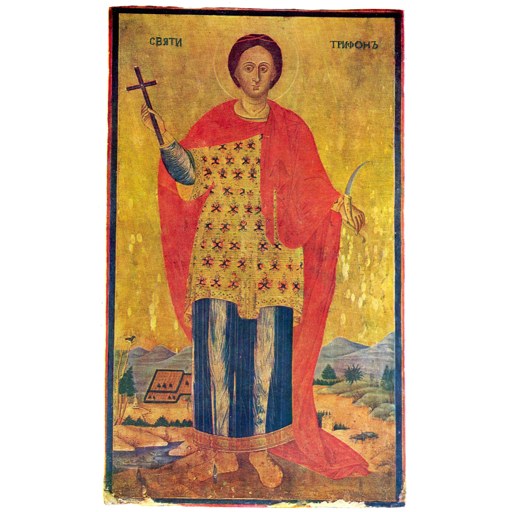
Dimitar of Sozopol
License: Public domain
Tryphon of Campsada
Saint- Life Span
- d. 250
- Feast Day
- 1 February (Eastern Orthodox); 10 November (Roman Catholic)
- Gender
- male
- Church
- Catholic
Places


Roles & Family
Patronage
gardeners;winegrowers;Moscow;Kotor;against insects;against locusts;against rodents;cattle;falconers
Biography
Tryphon of Campsada (also called Tryphon of Lampsacus) was a Christian martyr of the mid-third century whose biography is known almost entirely from later Greek synaxaria and a Latin passio rather than from contemporary documents. According to that hagiographical tradition he was born in the village of Campsada (Kampsade), near Apamea in Phrygia in Asia Minor, then within the Roman Empire. Western notices sometimes identify his birthplace with the Hellespontine city of Lampsacus, but the Phrygian village near Apamea is the usual Eastern identification. He is described as coming from a poor family and as working in boyhood as a gooseherd. The same sources ascribe to him, already in youth, the gifts of healing the sick and of driving out demons, which he is said to have exercised without leaving his rural occupation.
The central episode of the early life in the traditional accounts is the deliverance of a daughter of the emperor Gordian III (reigned 238–244) from demonic possession. Secular history does not independently attest this incident or the existence of such a daughter, and it must be treated as part of the later legendary narrative. In that narrative Tryphon declined imperial rewards and returned to Campsada; his reputation as a wonder-worker among both Christians and pagans is a consistent feature of the lives. He remained a layman and is not associated with any monastic or clerical office.
During the persecution that followed the edict of the emperor Decius (reigned 249–251), Tryphon was arrested as a Christian and taken to Nicaea in Bithynia. The passio presents an interrogation before a prefect named Aquilinus, a refusal to sacrifice to the gods, a conventional sequence of tortures, and death by beheading. The traditional date of the martyrdom is 250, which fits the opening of the Decian persecution, though the details of the trial cannot be confirmed from independent evidence. Christians are said to have recovered the body and carried it back to Campsada for burial. As with many third-century martyrs, the interrogation and tortures follow the stock patterns of martyr literature.
Veneration of Tryphon spread in both East and West. Relics were later translated to Constantinople and, in part, to Rome, where they have been associated with the church of Santo Spirito in Sassia; other relics are claimed by the cathedral of Kotor in Montenegro and by churches in Moscow and elsewhere. The Eastern Orthodox Church keeps his feast on 1 February; the Roman Martyrology commemorates him, together with the poorly attested companions Respicius and Nympha, on 10 November. He is invoked as patron of gardeners and winegrowers and against insects, locusts, rodents, and other pests that destroy crops, as well as for the protection of cattle. In the Slavic world, especially in Russia, the cult became particularly strong: he is counted among the patrons of Moscow, and a later Russian legend linking him with the recovery of a lost imperial falcon associated him also with falconers. There is no reliable evidence that he married or had children. He was never Bishop of Rome or a patriarch, and as an early martyr he belongs to the pre-congregation period of veneration.